









September 28, 2026
The Flowers Poisonous to Cats Organized by Real Danger
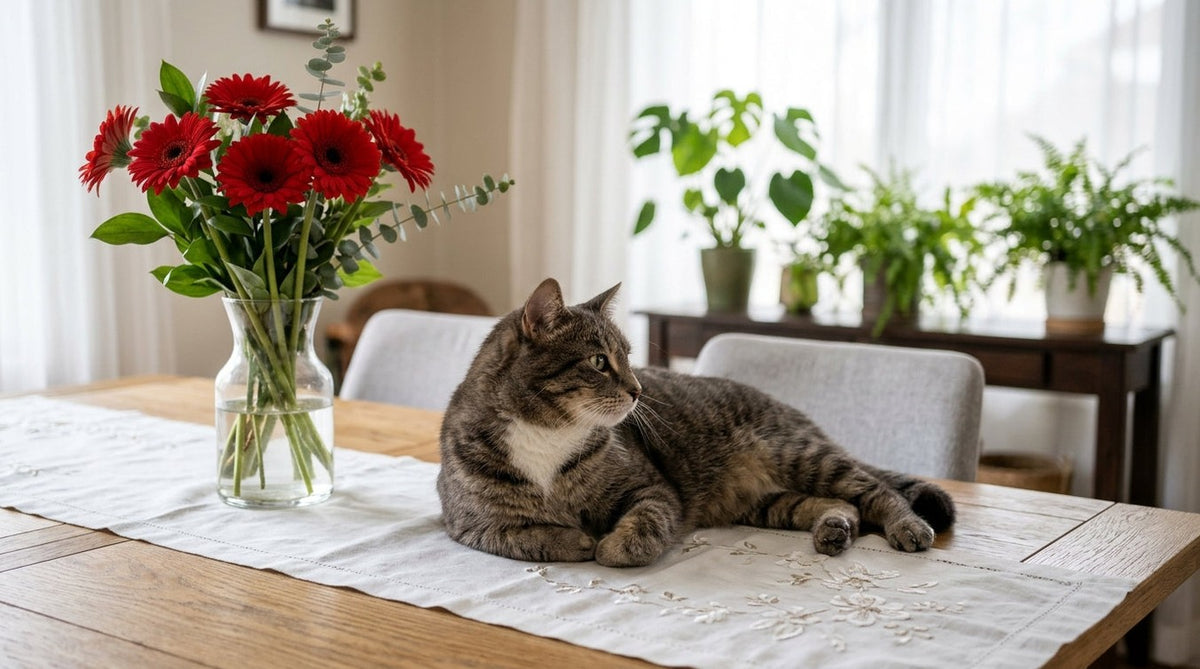
Most lists of cat-toxic flowers hand you a dozen plants sorted A to Z, with almost no hint of which one is a true emergency. A cat that nibbled a hydrangea leaf and a cat that brushed through lily pollen face completely different levels of risk.
Some of this confusion can be measured. A Cats Protection owner survey found over half of owners didn't realize lilies are dangerous to cats.
This guide aims to fix that. Owners rarely need a list of toxic plants; they need to know how worried to be right now, with flowers on the table and a cat licking its paws.
The ranking below is ordered by what each flower actually does to a cat, starting with the deadly one and ending with two that may stain a rug and do nothing worse.
Lilies and Daylilies: Kidney Failure From Tiny Exposures
Lilies are toxic enough that biting a single leaf or petal can trigger fatal kidney failure. Licking pollen from a paw can do it, and so can drinking vase water. The responsible toxin still hasn't been identified.
What is certain is the timeline. If treatment is delayed beyond 18 hours after exposure, kidney failure is usually irreversible, so time since contact matters more than how much was eaten.
Interestingly, dogs that eat lilies just get an upset stomach and their kidneys survive. Cats aren't so lucky.
Careful owners often get tripped up here, because pollen-free lilies are sold as a cat-safe choice. International Cat Care, in guidance reviewed by the Veterinary Poisons Information Service, makes it clear that since every part of the plant is toxic, removing the pollen doesn't make a lily safe.
The Roselily, a pollen-free hybrid typically marketed this way, is named on the dangerous-lily list from Pet Poison Helpline. Choosing it to protect your cat achieves nothing.
The dose surprises people too. Pet Poison Helpline warns that just 2 or 3 leaves or petals from a true lily can lead to severe kidney failure.
Names matter more than usual, because two genera cause all this harm: true lilies (Lilium) and daylilies (Hemerocallis). The Easter lily is the one most homes encounter; tiger and stargazer lilies appear in mixed bouquets year-round, and the Asiatic lily is a florist staple.
Symptoms start within 1 to 6 hours, so a cat seen chewing at breakfast should be watched closely by midday. They're also common enough that many owners blame a hairball:
- Throwing up
- Excess drooling
- Not wanting to eat
- Weakness or low energy
- Licking pollen out of a dusty coat
| Time since exposure | Possible signs |
|---|---|
| 1–6 hours | Vomiting and drooling |
| 6–12 hours | Vomiting fades and your cat seems improved |
| 12–24 hours | Increased thirst and urination |
| 24–72 hours | Kidney failure without treatment |
Lily cases often reach clinics late because of that middle phase. A cat that vomited in the morning and seems lively by lunch hasn't recovered, and that false improvement convinces owners to wait. An 18-hour window can't afford the delay.
What comes after that lull is measurable: rising thirst and urine output between twelve and twenty-four hours are signals of kidney injury setting in.
Even cats that survive lily poisoning may be left with lasting kidney damage that needs lifelong care.
Don't wait and watch. Take a photo or bag a stem, call your vet or an emergency line, and leave. Decontamination and activated charcoal are most effective early, and IV fluids help shield the kidneys while the toxin clears.
| First-hour step | Reason |
|---|---|
| Photograph or bag part of the plant | Knowing the species changes treatment |
| Phone the clinic before leaving | Staff can prepare and advise you en route |
| Write down when contact happened | The 18-hour window counts from exposure, not from symptoms |
If you live far from a clinic, note this. A University of Pennsylvania School of Veterinary Medicine study of 112 cats compared hospitalized cats on IV fluids with outpatients on fluids under the skin and found no meaningful difference in acute kidney injury. The researchers stressed this was not a treatment recommendation.
Survival was still higher in hospital, so treat this as encouragement to reach any vet you can, not a reason to stay home.
Autumn Crocus: Damage That Hides for Days
Autumn crocus defeats the wait-and-see approach. Other flowers here show signs within hours; this one may not.
The culprit is colchicine, which targets rapidly dividing cells, so harm to the gut, liver and kidneys may take days to appear rather than showing up that evening. Every part of the plant contains it. Waiting for symptoms gives false reassurance, and any contact is reason to call.
Daffodils: Bulbs Are Worse Than Stems
A cut daffodil in a vase and a bulb in a pot pose different risks.
Lycorine is found throughout narcissus plants but is concentrated below ground. Chewing a cut stem usually causes drooling and vomiting. Digging up and gnawing a bulb can bring abdominal pain, heart rhythm disturbances and, in severe cases, seizures.
This matters most in fall, when bulbs sit in sheds and freshly dug beds, which is why daffodil cases tend to cluster then. Plant bulbs where your cat won't dig.
Tulips and Hyacinths: Most Toxin Sits in the Bulb
Tulips and hyacinths are in the same family as lilies, which makes them look more alarming on lists than they deserve.
In tulips, tuliposide A and tulipalin A cause the harm; in hyacinths, allergenic lactones do. Both are concentrated in the bulbs, with much lower levels in leaves, stems and blooms. Which part your cat got into determines your level of concern.
| Part reached | Typical result | Possible with larger amounts |
|---|---|---|
| Cut tulip stem | Vomiting and drooling | Seldom more than a rough day |
| Tulip bulb | Stronger version of the same | Irregular heartbeat and labored breathing |
| Hyacinth bulb | Irritated mouth and throat | Wobbliness and a swollen face |
| Daffodil bulb | Vomiting and drooling | Belly pain and seizures |
A note of caution: one poison control service lists cut tulips among safer options, which can sound like "harmless." A single nibbled petal is unlikely to cause serious problems, but a swallowed bulb is different, and large amounts of tulip material have caused heart signs, breathing distress and sudden death.
An easier rule than memorizing each bulb: if it grows from a bulb, keep the bulb away from your cat.
Azaleas and Rhododendrons: A Threat to the Heart
So far, the serious flowers have targeted the gut or kidneys. Azaleas and rhododendrons hit a different organ.
Their grayanotoxins disrupt the sodium channels muscles need to fire correctly, including heart muscle. A poisoned cat may drool and have diarrhea like any plant case, then progress to an abnormal heart rate, tremors and seizures. The worry is how little it takes: chewing a few leaves while hiding under a hedge can land a cat at the vet, and azaleas are popular hedge plants.
Oleander: Even the Vase Water Is Toxic
Keep an eye on vase water as much as the flowers. Oleander is the second flower here whose water can poison a cat, turning vase water from a lily oddity into a general cut-flower rule. Its cardiac glycosides act directly on heart muscle and are present in leaves, flowers and the water they stand in. Signs range from drooling to poor coordination to fatal heart rhythm changes.
It's not strange for a cat to drink from a vase. The water moves when a stem is bumped, smells of plants unlike a bowl or stainless steel fountain, and sits at face level on a table, enough to intrigue an animal that explores with its mouth.
So cover vases or keep them out of the cat's rooms, whatever flowers they hold. It's the cheapest fix on this list. If your cat has begun drinking from unusual places, mention that to your vet for separate reasons.
Foxglove and Lily of the Valley: Heart, Not Kidneys
Lily of the valley has "lily" in its name and almost nothing else in common.
Its cardenolides act like digitalis, so the heart is at risk, and in severe cases an abnormal rhythm turns life-threatening. Foxglove works through the same chemistry.
Two more are misclassified for the same reason. Peace lilies and calla lilies aren't true lilies either. Their calcium oxalate crystals cause painful irritation of the mouth, occasionally serious if the airway swells, but the danger stays in the mouth and throat.
Precision matters at the clinic. If you tell the vet your cat ate a lily and it was actually lily of the valley, they'll start by examining the wrong organ.
Chrysanthemums: A Natural Insecticide
A cat that's wobbly after chewing flowers may well have gotten into chrysanthemums. Mums contain pyrethrins, natural insecticides.
A synthetic version of this chemistry is likely in a flea product somewhere in your home, and cats are notoriously sensitive to it. Sesquiterpene lactones are also present. Besides vomiting, expect unsteadiness and sometimes irritated skin where the plant touched. The wobbliness is often the clue that identifies the flower.
Cyclamen: Roots Far More Dangerous Than Leaves
Potted cyclamen shows how one plant can sit at two points on the scale. Sold as a winter houseplant, it often ends up on a reachable windowsill.
Its saponins are spread throughout but heavily concentrated in the tubers and roots. Chewing a leaf or flower usually means drooling, vomiting and diarrhea.
Getting into the root, however, can cause an abnormal heart rate and rhythm, potentially fatal in large amounts. So with cyclamen, the key question isn't whether your cat chewed the plant but whether it dug into the pot.
Amaryllis: Same Toxin as Daffodils
Amaryllis usually arrives at Christmas, boxed with its own pot, and owners think of it separately from garden daffodils.
It's the same family, though, with lycorine concentrated in the bulb below the soil while the bloom above is relatively harmless. Expect drooling and vomiting, plus stomach discomfort and lethargy. Treat a gift amaryllis exactly like a tray of daffodil bulbs.
Hydrangea: Only an Upset Stomach
Typography quietly misleads on these lists. Hydrangea appears on all of them in the same font as lilies a few lines up, flattening very different risks into one.
Documented signs are vomiting, diarrhea and lethargy, with no organ failure and no heart involvement. Nothing here warrants a midnight drive across the state.
It's included because a useful ranking must also tell you what not to worry about.
If your cat only nibbled a hydrangea today, watch the litter box and offer water, and call your clinic in the morning if things haven't settled.
Iris and Gladiolus: Unpleasant but Not Damaging
Something has to be at the bottom of the ranking, and iris and gladiolus show what "toxic" means at that level.
ASPCA Animal Poison Control names pentacyclic terpenoids as the toxic principle in iris, while no compound has been pinpointed for gladiolus. Both cause brief drooling and salivation, sometimes followed by lethargy and diarrhea in mild cases. Neither harms the kidneys, liver or heart.
Baby's Breath and Filler Greens: Usually Unlabeled
The least worrying stems on their own are the hardest for owners to identify.
Baby's breath, a common filler, is mildly toxic, typically causing vomiting or diarrhea and rarely anything more. Eucalyptus, dusty miller and ruscus appear in bouquets at a similar level of risk. None warrant panic.
The problem is that they make a bouquet impossible to evaluate at a glance, since none of them are labeled. Almost all toxic flowers enter homes as gifts, wrapped up with a card and price tag but no list of contents.
| Source of the flowers | Information available |
|---|---|
| A florist you use | Everything, if you ask before it's made |
| Grocery store bunch | Main blooms only, and not reliably |
| Delivered gift | Typically none |
Cat behavior researcher Dr Mikel Delgado looked into what shoppers are actually told. She also cited the statistic behind this whole article: in one study of owners whose cats had eaten lilies, just 27% knew beforehand that lilies were toxic. Her findings from stores were even starker: Easter lily plants carried no warnings, only a barcode and a price.
One florist admitted to her that she doesn't routinely ask about cats because she'd be asking all day long.
That suggests one practical step: don't count on labels, and give your florist the Latin name of anything to exclude. Common names are unreliable, and in an emergency owners often can only recall that the wrapper said "premium lilies."
Tell anyone else caring for your cat as well, whether you bring your cat along on trips or leave it with a sitter.
Beyond sitters, some cats have much less margin for error. Kidneys already working below capacity can't absorb a toxic hit, so the same exposure does more harm. For these cats, keep flowers out of the house.
| Health background | Suggested approach to flowers |
|---|---|
| No history of urinary or kidney issues | Ban true lilies; keep other flowers off jumping paths |
| Previous urinary problems | Keep lilies and bulb flowers out of the home completely |
| Diagnosed kidney disease | Only cut flowers confirmed on a verified safe list |
Owners seldom link these facts. A cat treated last winter for urinary tract symptoms is mentally filed as fixed, and the hallway bouquet as décor, but your vet sees them as related.
A cat that has ever had urinary crystals belongs in the same group, and a kidney disease diagnosis settles it. Such a home should have no lilies anywhere.
Only your vet can examine and test your cat properly. If you're not sure what's in a vase, take a photo and ask.


