









July 22, 2026
Five Underdiagnosed Cat Skin Problems (Beyond Fleas and Food)
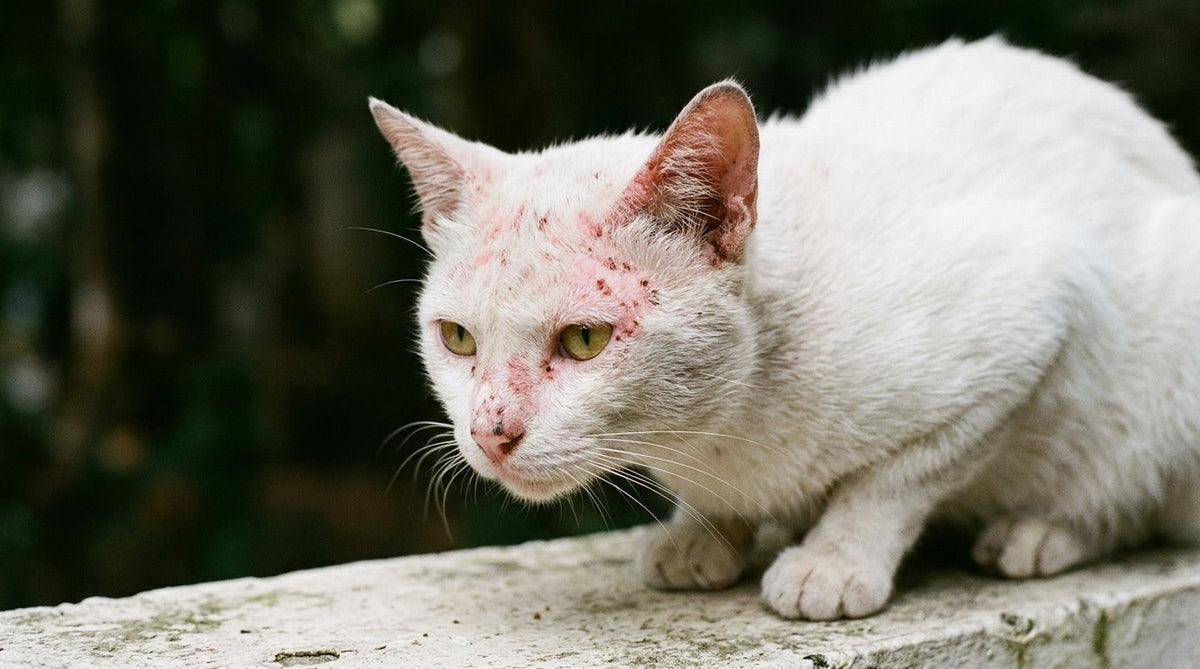
The vet visit is done and fleas have supposedly been ruled out. Yet your cat keeps scratching those identical spots, and fresh scabs show up even after weeks of treatment that should have calmed the itch by now.
This is the point where stubborn feline skin trouble tends to slip through the cracks.
Perhaps the elimination diet ended and the scratching never stopped, or you are halfway through and seeing no change at all.
Below are five causes that are easy to overlook. For each one you will find something to try at home first, plus a realistic price for the diagnostic test that confirms it.
Household Allergens: Dust Mites, Bedding and Fragrance
Start by taking a careful look at the room where your cat sleeps.
Many itchy cats are reacting to things inside the house: bedding, perfumed litter, and leftover residue from fragrances or cleaning sprays that the cat brushes against every day.
The medical term is feline atopic skin syndrome, and vets arrive at it by exclusion. It is what remains once parasites, infection and food have been crossed off, not something one test proves. Blood allergy panels look at IgE, not IgG, they typically cost $250-$350, and their main use is to pick an immunotherapy plan, not to confirm the condition.
Try the home protocol before you pay for that panel. In one online cat forum, an owner described an indoor cat who had been scratching at her neck for three months and came home from the vet with a diagnosis of "unspecified allergies." A commenter who said they worked as a vet tech suggested atopic dermatitis as the most likely explanation.
The usual dust mite cleanup looks like this: a HEPA vacuum with a sealed canister, encasements on mattresses and pillows, an allergen-rated furnace filter, and bedding washed in Demite detergent.
Humidity is part of the picture as well. Dust mites stop breeding below 50% relative humidity, so putting a compact dehumidifier where your cat sleeps is an inexpensive way to test the theory.
Give these changes four to six weeks before booking allergy tests, because that is how long environmental fixes take to show results. Have your vet rule out parasites and skin infection first, since those two are behind many more itchy cats than atopy is.
Chin Acne: The Overlooked Problem Linked to Plastic Bowls
Now take a look under your cat's chin and along the lower lip.
Tiny black dots, red skin, and occasionally a firm bump along the jawline all point to feline chin acne. It is a skin issue that keeps coming back, and it is closely linked to the bowl your cat drinks from.
Plastic dishes are the usual suspect, and Green Cross Vets is one of the clinics that call them out. Plastic picks up fine scratches quickly, and those grooves give slimy biofilm a place to grow. Your cat presses her chin against the very same spot every time she drinks.
At that contact point the skin barrier wears down. Bacteria move into the hair follicles, and an infection can set in.
Whatever label ends up in the chart, swapping the bowl comes first and seeing your vet comes second, because well-established cases often need a topical treatment or antibiotics. Chin acne also tends to return, so think of it as something you manage rather than cure.
Start With a Stainless Steel Drinking Surface
Changing the bowl is the least expensive step, and steel stays easy to scrub clean even as it gets older. That idea is behind our Wireless Cat Fountain 2.0.
Its water-contact surfaces are 304 food-grade stainless steel. When your cat's chin is already irritated, the key point is that the rim she leans on can be cleaned thoroughly, which a scuffed plastic dish simply cannot offer.
If the bowl was the culprit, the redness usually calms down first and the fur grows back afterward. If you see no change after a month, the bowl probably was not the problem.
If your cat has chin specks and currently drinks from plastic, switching to a stainless option such as the Wireless Cat Fountain 2.0 is a sensible first change. Ask your vet to examine the chin too, especially if you feel hard lumps or see broken skin.
Food Allergies: Why the Elimination Diet Takes 8-12 Weeks
When your cat is still scratching partway through an elimination diet, the trial may simply not be finished. It needs time.
According to the Cornell Feline Health Center, a strict elimination diet lasts 8 to 12 weeks. Just one week of accidental exposure sends the count back to zero.
The usual sources of contamination are easy to miss: a treat from the neighbor, kibble stolen from a roommate's cat, or a flavored deworming pill.
There are two diet types to discuss with your vet. A hydrolyzed diet breaks the protein down so far that the immune system no longer recognizes it. A novel protein diet uses something your cat has never eaten, like rabbit or duck.
According to VCA, the allergens cats react to most often are beef, chicken, and fish. For a cat that has eaten chicken since kittenhood, a novel protein is usually the cleaner choice.
Both approaches take the same amount of time to interpret. By week six there is often a hint of an answer, but you still need the complete eight-to-twelve-week trial, and only a calm coat by the end tells you food was responsible. Omega-3 is sometimes added to support the skin barrier, and the dose is worth confirming with your vet.
Hot Spots and Over-Grooming Caused by Stress
The medical name, psychogenic alopecia, refers to over-grooming driven by stress. It does happen, but it is less common than many owners think, and it should be the last explanation reached, not the first. Fleas are still the most frequent cause and the cheapest to rule out, so treat thoroughly for parasites before you treat anxiety.
Behavioral over-grooming also looks different from allergic itching.
It tends to show up as matching bald areas on the belly and inner thighs, rather than on the head or back. Cats also lick that region when they have urinary discomfort, so that needs to be excluded before calling it behavioral.
The skin beneath usually looks normal, without redness or swelling. The cat is essentially licking the fur away.
Three everyday changes that commonly unsettle a cat:
- A new pet spending time near where your cat usually grooms.
- Furniture moved away from the cat's usual scratching routes.
- A change in the household schedule that the cat experiences as stress.
Online cat forums show the same split between behavioral and medical causes. One owner described months of over-grooming on a single bald spot and ran into a wall: the vet found nothing medical, and both Feliway and calming supplements failed to help.
In the same discussion, another owner reported the exact same bald-patch pattern. For them, the cycle ended once the source of stress, a steady stream of foster kittens coming through the house, was taken away.
A cycle-break approach interrupts the habit. A baby onesie or a recovery cone keeps your cat off the area and gives the skin about ten days to recover. While the cover is on, think back over the two weeks before the grooming changed, figure out what was different at home, and remove that trigger.
If the area stays clear once the cover is off, behavior was the cause. If the problem comes back, it is time to bring in a feline behaviorist.
Flea Allergy When You Can't Find a Single Flea
Among all feline skin conditions, flea allergy dermatitis (FAD) ranks as the most frequent.
What many owners do not realize is that the reaction is to flea saliva. A single bite can cause three to four weeks of itching, long after the flea itself has disappeared.
Indoor cats get FAD often, and that lag is the reason it is hard to spot for owners and vets alike at the first visit. On the day of the exam, there may be no parasites to see.
Here is a real-world example. An owner in the American northeast posted online that Frontline was not killing the fleas on their cat. Resistance to certain active ingredients has been documented in some regions, and in their case switching to Advantage II solved the problem.
For that owner, Advantage II (imidacloprid) succeeded where Frontline (fipronil) did not. Different products use different active ingredients, and some older ones have shown weaker results in certain areas, so if a product is not working, your vet can move you to another class. Ticks work on a similar saliva-based principle.
That is why a treatment trial becomes the true test. Treat all the pets in your household with a flea product your vet recommends, and keep going for 8 to 12 weeks. Should the itching calm down, fleas were behind it even though you never saw one. Only use products labeled for cats, because several dog spot-on treatments contain permethrin, which is lethal to cats, and let your vet decide on any antihistamines or steroids.
Get Ready for the Vet Before Paying $300 for Allergy Testing
Arriving prepared can spare you a whole second appointment.
Take this list with you to the visit:
- Dated photos showing the sores and any crusting.
- The date any elimination diet began.
- Each topical treatment you used and when.
- Any stressful events or routine changes in the eight weeks before the symptoms started.
Typical 2026 US prices: cytology about $50-$80, a fungal culture $40-$80, a skin scrape $50-$150, and an allergy panel $250-$350. Allergy injections average around $78 per dose.
With those figures in mind, start with the less expensive tests. Cytology detects bacterial and yeast infections, while a skin scrape and tape test check for mites, including Cheyletiella, which can pass to other pets. Ringworm calls for a fungal culture or PCR instead of a scrape, and allergy testing comes at the very end.
In the end, your veterinarian is the one examining your cat, and the order of testing is their call.
If anything seems urgent, have your cat seen today instead of working through this list.