









July 23, 2026
How To Prepare Cats For Travel And Make Them Comfortable
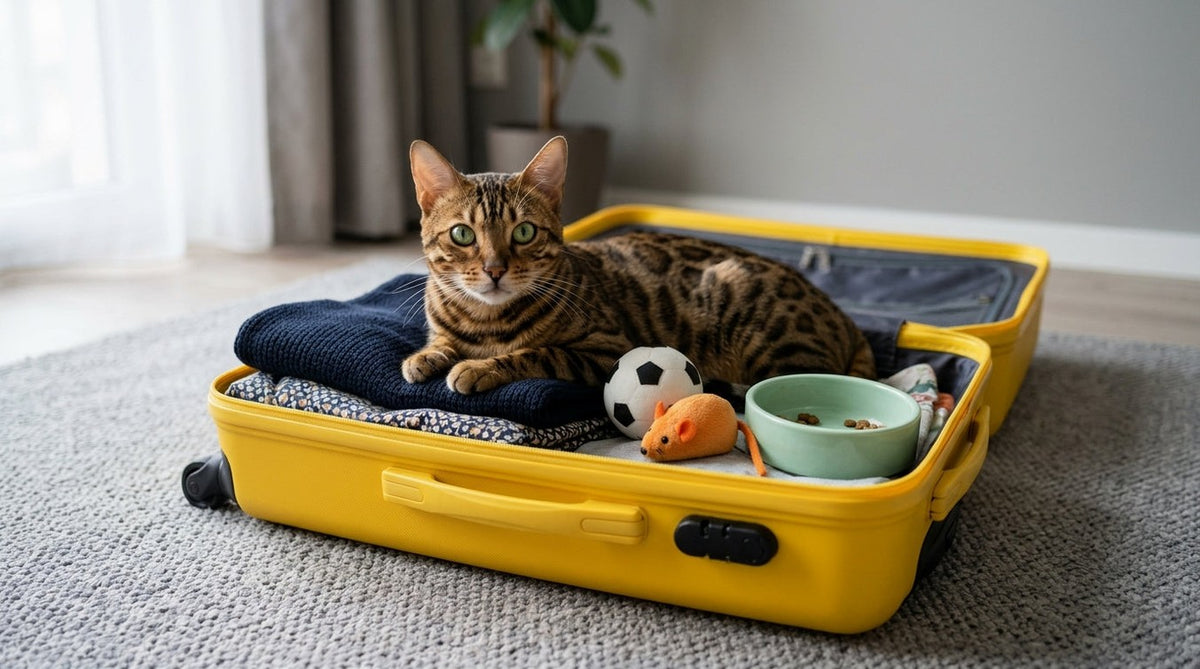
A trip is coming up, your cat has to come along, and your cat is an indoor homebody who has hardly been out the front door.
Relax: your cat will cope, as long as you understand what a broken routine does to its body and how to keep things steady.
The advice here draws on AAFP and ISFM cat-friendly guidance and on real experiences shared by cat owners on Reddit's r/CatAdvice.
How Travel Affects Your Cat's Body
We tolerate travel because we know it will end. Your cat has no way of knowing that. Its nervous system interprets strange motion and the hum of a car engine as an ongoing danger, and losing the familiar smells of home makes it worse.
The most noticeable effect during the journey is a drop in both appetite and thirst. That's a stress reaction, not some ancient desert instinct kicking in, and it's the same reason cats refuse food in a boarding facility or a hospital cage.
Ten hours in a carrier without eating also means ten hours without drinking, and dehydration progresses faster than hunger.
Stress-related loss of appetite and thirst is well recognized in cats. The AAFP and ISFM guidelines identify the carrier itself as a major source of travel anxiety, which is why getting your cat used to it beforehand matters more than any discussion of sedatives.
One owner on r/CatAdvice described a cat that drooled for the entire nine-hour drive and wouldn't drink anything until they arrived. Two weeks of preparation prevents most of that.
If your cat is a reluctant drinker even at home, our ideas for encouraging cats to drink cover the wider hydration picture.
Your Two-Week Countdown
Something has to become dull before it can feel safe, and that takes more than a weekend. Cramming preparation into the last two days achieves very little.
Fourteen days before departure, set the carrier in a sunny spot with the door propped open. Add treats and soft bedding, and let your cat ignore it until it's no longer a big deal.
Ten days out, schedule a vet appointment and talk about sedation if your cat is a poor traveler. Gabapentin is the medication vets reach for most often; it must be prescribed for your individual cat, so never give leftover pills or another pet's medicine. Request a test dose to try at home a week ahead.
Any travel sedative should be tried well before the day you leave, never for the first time that morning.
One week out, start brief practice drives: ten minutes around the neighborhood with the carrier buckled in, then home to a quiet room. Do this every other day.
Three days before departure, start using a synthetic feline facial pheromone spray inside the carrier. These products mimic the calming scent cats leave when they rub their cheeks on furniture, and AAFP guidance supports pheromone products for travel anxiety.
On travel day, pack water, the pheromone-treated carrier, and your cat's microchip details and rabies vaccination records. Then hit the road.
Staying Calm in the Carrier, Car and Plane
Each of the three settings below needs something different from you. In all of them, remember you're handling a stress reaction, not misbehavior.
If your cat has any health problems, get your vet's approval before traveling.
Inside the Carrier
Drape a cover over it. Cats calm down faster when they can't see the outside world, and covering the carrier is a standard low-stress technique. Make sure air can still flow, and add a blanket that smells like home.
On the Road
Strap the carrier into the middle of the back seat with a seatbelt. Keep the car around 68–72 °F, and never leave your cat in a parked vehicle, which can become deadly hot within minutes. Offer fresh water at each stop.
Rest stops are the biggest escape risk of any road trip. Don't open the carrier unless a leash is already attached to your cat. Gas station escapes are how indoor cats get lost in towns they've never seen.
Accounts of those moments are all over r/CatAdvice, and the story is always the same: the cat was supposedly out for just a moment.
On a Flight
Use a soft-sided, TSA-approved carrier that fits under the seat, and book your cat on the same airline as you. Choose cargo only if there's truly no alternative; the hold is noisy and cold, triggering the worst form of travel anxiety.
Flat-faced breeds such as Persians and Himalayans are often restricted by major US airlines because of breathing risks in pressurized cabins, so review the airline's pet policy before booking. Rabies vaccination must be up to date, and your cat's microchip should list your current address.
Taking Familiar Water With You
Here's what nobody plans for: the drinking setup you spent months perfecting is the one thing you can't pack, because it needs an outlet.
A cordless fountain like our Wireless Cat Fountain 2.0 changes that. It only needs a flat surface, so a counter at a relative's house works just as well as your own.
That matters because a new bowl at your in-laws' place looks unfamiliar, the water tastes different, and the flowing-water cue from home is missing. Bringing the same fountain carries that cue along, with the same object and the same faucet-style stream.
Set it up in a kitchen hundreds of miles away and your cat recognizes the drinking spot it has used for months at home.
Change the water and rinse the fountain just as you would at home. Being cordless, it works wherever the outlets happen to be in a guest room.
Its 304 food-grade stainless steel resists the scratches where biofilm takes hold, so buildup is much slower than in plastic and it cleans easily on the road, in under 5 minutes. The broad bowl stays the same in every kitchen, and a pump under 25 dB keeps things quiet in a strange house.
For a cat that won't drink in unfamiliar places, familiarity works better than coaxing.
The First Three Days Back Home
You made it home. Expect your cat to act a bit odd for two or three days; that's normal. Knowing what's normal and what needs a vet is the final step in traveling well with a cat.
Day One
In the first 24 hours, expect hiding under beds, behind couches or in a quiet closet. Your cat is rebuilding its scent map of home.
Help by putting out food, fresh water and a clean litter box, then give it a few hours of peace.
Appetite usually returns within about half a day. Hepatic lipidosis becomes a risk after two days without food, so keep count rather than waiting it out. That article also covers dehydration timelines.
Day Two
Drinking usually resumes before eating. If your cat is drinking within a day of returning, the rest typically falls into place.
This is when a flowing fountain really helps, since the moving water encourages rehydration without you needing to coax.
Day Three
By now, sleeping spots, appetite and bathroom habits should be back to normal.
Some cats need all three days, which is the upper limit of normal recovery, not the minimum.
Warning Signs
Two limits matter: a full day with no water, or two days with no food, and earlier for kittens or overweight cats. Hiding for more than 72 hours belongs on the same list. Straining in the litter box with nothing coming out, especially in a male cat, means going to the vet immediately.
Two weeks of preparation, a covered carrier and three days of patience afterward make up most of the difference between a stressful trip and a smooth one.
Once these pieces are in place, most cats handle several trips a year without trouble, and owners who travel regularly find the planning becomes second nature.