






September 29, 2026
Maine Coon Personality: An Honest Guide For First-Time Owners
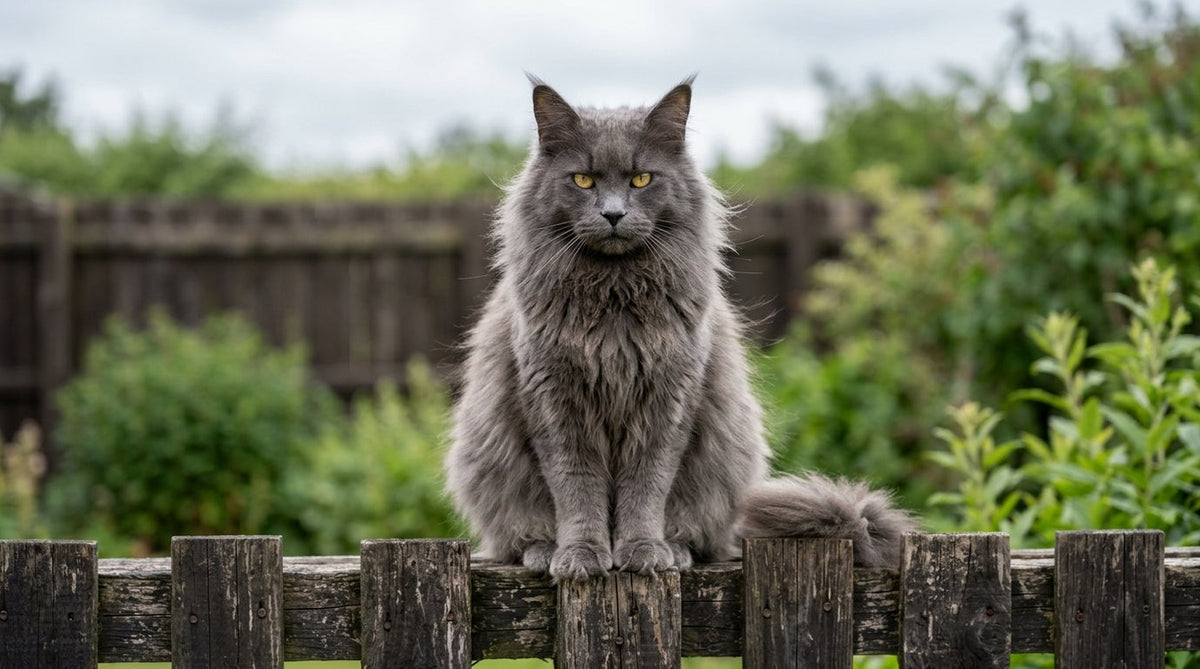
The Cat Fanciers' Association released its yearly popularity list in 2026, and for the second straight year the Maine Coon took first place among pedigree breeds.
Considering one as your first cat? Expect a big, chatty companion that shadows you around the house. The "gentle giant" nickname is well deserved.
Here we look at what Maine Coons are like, how to keep one healthy, and whether the breed suits your household.
Still gathering supplies? Our checklist for new kittens handles the gear; this article focuses on the cat itself.
How Sociable Are Maine Coons?
Very, and more consistently than most breeds. A well-socialized Maine Coon often strolls up to greet visitors before the doorbell has stopped ringing, and they generally get along with dogs and other cats.
Their friendliness tends to be on their own terms: they approach and hang around because they choose to. A Maine Coon owner on Reddit's r/MaineCoon described her cat as refusing to settle for a lap, insisting instead on climbing all the way onto her chest. Try to hold one still, though, and it usually slides right back down to the floor.
Temperament at Home
Think of a Maine Coon as a supervisor. It posts itself in the doorway of your current room, follows you into the bathroom, and moves whenever you move.
What many won't do is curl up on you. A longtime owner on that forum observed that the breed tends to want proximity rather than cuddles.
Their sheer size shapes this too. Another member noted that lap-sitting is rare and perhaps just as well, since her 12 kg female hurts when she walks across her.
People sometimes conclude their cat isn't properly bonded. That doesn't follow: many deeply attached cats show it by staying nearby without ever climbing aboard.
Choosing a Favorite Person
Most Maine Coons attach most strongly to one human, and it often isn't whoever fills the food bowl. The same owner mentioned above noticed exactly this.
If you weren't the one picked, that's normal and says nothing about you. The cat isn't ranking family members; it simply gravitates to the person whose routine feels most predictable.
Splashing Isn't the Same as Drinking
One trait is frequently misunderstood. Owners report Maine Coons inspecting every sink, and one described hers stepping into a shallow bath to yank out the plug and watch the water drain.
Playing with water is a real part of the breed's character, but it reveals almost nothing about hydration. A cat that splashes joyfully may still not drink enough.
Play and drinking are separate behaviors, and only drinking tells you whether intake is adequate. If you seldom see your cat drink, our guide for cats that aren't drinking walks through what to check.
Nature, Nurture and Early Weeks
Many owner concerns boil down to one question, even when phrased differently: "My cat isn't as affectionate as described," or "Mine hides from guests."
Two separate factors shape most of the personality you'll actually live with, and frankly, neither is anyone's fault, least of all yours.
Siblings Can Be Opposites
Genetics is the first factor, and the Maine Coon is one of the rare breeds where it has been studied directly. Milla Salonen and the University of Helsinki's canine and feline genetics team carried out the first heritability study of feline behavior traits.
Their dataset included roughly 6,000 cats from 40 breeds, and Maine Coons were among just three breeds with enough cats for full analysis. Breeds varied, most noticeably in activity.
Another result matters more for you: there's considerable genetic variation inside each breed as well, so any breed profile you read is just an average across very different individuals.
Households confirm this. One forum member said her two Maine Coons are littermate sisters with completely distinct personalities.
In another thread, one person insisted the breed doesn't snuggle, and the very next reply said her cats want nothing but snuggles. Both were accurately describing real cats.
The Socialization Window: Weeks Two to Seven
The second factor rarely comes up when people buy their first kitten. Kittens go through a sensitive phase from roughly two to seven weeks old, with some flexibility lasting to about nine weeks.
In that phase, the brain is especially adaptable, so experiences leave an outsized, lasting mark on behavior and emotional responses. Being handled then is a big reason a cat later seeks out people.
The catch is timing: nearly all of this happens before you meet your kitten. In January 2026, Elin Netti Hirsch and colleagues at the Swedish University of Agricultural Sciences surveyed 133 pedigree breeders, and just 2.3% correctly named that window.
Beliefs and practice also diverged:
| Topic asked about | Rated it important | Actually did it |
|---|---|---|
| Several different people handling kittens | 93.2% | 76.7% |
| Kittens meeting non-feline animals | 71% | 32% |
About a third of breeders in the survey also said kittens got under forty minutes of handling daily. The point isn't blame, and the researchers didn't assign any; they concluded breeders need easier access to guidance.
The practical lesson, as the authors frame it, is narrower: whether a kitten enjoyed rich first weeks was largely chance, and it remains one of the best predictors of the adult cat you'll share your home with.
Ask About the Litter's Early Handling
Breeders don't keep formal handling logs, but they remember. Ask how many people handled the kittens, how much time they got each day, and whether they met dogs or other pets. A breeder who paid attention will answer readily, and good ones like the question.
Even a thin answer is useful information. A cat's relationship with people keeps developing until about sixteen or seventeen weeks.
Learning Soft Mouths
That early period also teaches something especially important for this breed. Social play starts near four weeks, peaks from six to nine weeks, and fades by fourteen.
Littermates teach each other how rough is too rough. A kitten removed early or raised alone may never have learned.
Size is why it matters. In most breeds you'd get a slightly nippy cat. Here, as one forum owner warned, they mature slowly, so you can end up with an enormous kitten capable of real damage.
If your young Maine Coon plays too roughly, switch to a toy the instant you feel teeth, and start while the cat still weighs less than a bag of sugar.
How Big Do Maine Coons Get?
Size influences personality more than newcomers expect, and owners routinely underestimate it. What catches people off guard is how long the growing takes.
The International Cat Association lists the Maine Coon among the biggest natural domestic breeds, notes that it matures slowly and may not finish growing until age 3 to 5, and gives typical adult weights of 18–22 lb for males and 12–15 lb for females.
Compared With an Ordinary Cat
An average adult house cat weighs about 4 kg, just under 9 lb. So a male Maine Coon at 18 to 22 lb is around twice that, with big females not far behind.
More surprising still, a male can outweigh a typical full-grown house cat by about six months of age while still behaving entirely like a kitten.
Growth Curve to Adulthood
Weight follows a fairly predictable path, with females a few pounds lighter at every stage:
| Age | Male weight | Female weight |
|---|---|---|
| Three months | 5–7 lb | 4–6 lb |
| Six months | 9–12 lb | 7–10 lb |
| Twelve months | 14–18 lb | 10–14 lb |
| Twenty-four months | 18–22 lb | 12–15 lb |
Those figures conceal a useful detail: most weight arrives in the first ten months, and year two adds much less than the final numbers imply.
The body keeps changing for years afterward. Height and length generally settle between two and three, while chest depth and muscle continue to fill in until four or five, especially in males.
By contrast, most house cats are physically mature at twelve to eighteen months, so expect a growth period two to four times longer than usual.
Maine Coon Life Expectancy
Most live 12 to 15 years, though published figures vary more than you'd think, depending on which population was studied.
Those differences are worth understanding. Swedish insurer Agria, drawing on data from about 50,000 insured cats, reports a median Maine Coon lifespan above 12.5 years.
The detail behind that median matters more: Agria's records show 74% of the breed reached age ten, a useful number to keep in mind when deciding.
One caveat: insured cats tend to be healthier than the breed overall, so read that median as the better half of the picture, not a guarantee.
Sex and lifestyle shift it too, more than owners assume. Females usually outlive males, and indoor cats outlive outdoor ones. Three breed-linked conditions explain much of the gap, and all three can be screened for before purchase:
| Health issue | Frequency in Maine Coons | Request from the breeder |
|---|---|---|
| Hip dysplasia | Frequent in this breed | Hip scores for sire and dam |
| Hypertrophic cardiomyopathy | Main heart risk for the breed | A31P DNA test results |
| Spinal muscular atrophy | Roughly 1 in 7,000 | SMA carrier status |
Start with joints, which are screened by X-ray. Hip dysplasia is common in Maine Coons in a way it isn't for most cats, with over a third of screened cats showing some radiographic sign. Severity increases with age and body mass, and given the weights above, that matters a great deal.
Keeping weight in check is really about protecting joints. Owners typically notice joint pain well before a vet does, and early signs often look like this:
| Change at home | Common meaning |
|---|---|
| No longer uses a favorite high shelf | Early joint discomfort |
| Pauses before leaping onto the bed | Less confidence in the back legs |
| Irritable when touched near the rear | Hip or spine pain |
| Begins sleeping downstairs | Avoiding stairs and heights |
It's tempting to read these as a cat getting crabby with age. In this breed, book a vet visit instead, because pain can be treated while a personality change can't.
Next is the heart. Hypertrophic cardiomyopathy, a thickening of the heart muscle, is the most common feline heart disease, and in Maine Coons it's linked to mutations in the MYBPC3 gene.
The A31P mutation has been found only in Maine Coons among pedigree breeds, which is why there's a breed-specific test. Carrying it doesn't guarantee disease, because penetrance is incomplete.
Hip scores and A31P results are paperwork. The behavior changes above are what you'll spot first, often long before any retest, so it's better to overreact when a Maine Coon stops jumping than to wait. Kidney disease also shortens lives in this breed; read our overview of feline kidney disease too.
How Much Water a Maine Coon Needs
That growth table doubles as a hydration table. Cats need roughly 50 mL of water per kilogram of body weight each day, so a Maine Coon's requirement about doubles between six months and two years, while the bowl stays the same. By two, a male needs around half a liter daily.
| Type of cat | Usual weight | Daily water from all sources |
|---|---|---|
| Typical adult house cat | 4 kg | Around 200 ml |
| Grown female Maine Coon | 6 kg | Around 300 ml |
| Grown male Maine Coon | 9–10 kg | Around 450–500 ml |
Why the Kitten Bowl Falls Short
The bowl didn't grow with the cat. It was bought in month one, and by eighteen months the cat has doubled while the bowl hasn't. For the bigger picture, see our fountain versus bowl comparison.
Choose a Fountain With Room to Grow
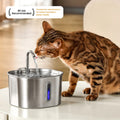
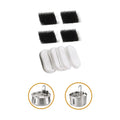
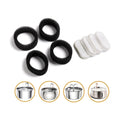
Much of what you buy in week one is sized for a kitten that will be gone by month eight. For a cat this large, a higher-capacity option like our 4L Stainless Steel Cat Fountain makes sense, built from 304 food-grade stainless steel with activated carbon filtration and a pump under 25 dB.
Its wide basin suits a big face, and the stainless parts are dishwasher-safe. Size your setup for the adult cat at year three, not the kitten in your arms.
One final point, because it works in the other direction. Rising water use in a growing Maine Coon usually reflects growth, but a jump unrelated to size can be an early sign of kidney disease or diabetes, so learn the signs of feline dehydration as well.


