







September 29, 2026
Healthy Cat Weight Charts & Guide
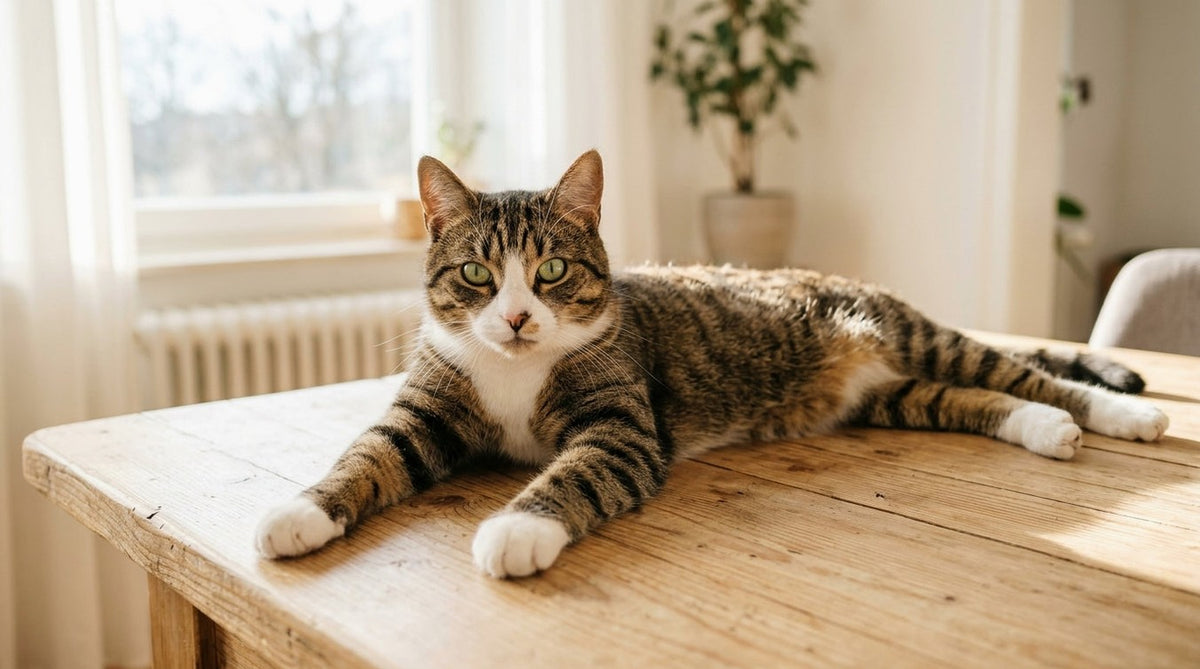
Most healthy adult cats weigh somewhere from 8 to 12 lb (3.6 to 5.4 kg). The average sits near 10 lb, and if someone demanded a single figure, that would be it.
Yet that range tells you very little about your own cat. Bone structure shifts the target, and so does muscle mass.
Below you'll find a chart to compare against, then a hands-on method for judging condition at home, and finally advice on slimming a heavy cat down safely.
Weight Chart by Life Stage (lb and kg)
A useful chart shows a target that shifts over the years. Healthy weight tends to rise into middle age, then drift lower in the senior years.
| Stage of life | Usual healthy weight (lb) | Usual healthy weight (kg) |
|---|---|---|
| Kitten, up to about 4–5 months | About 1 lb for each month of age | About 0.45 kg for each month |
| Kitten, 5–12 months | Growth varies a lot; follow the trend line | Follow the trend line |
| Adult, 1–6 years | 8–12 lb | 3.6–5.4 kg |
| Mature, 7–10 years | Males roughly 11–12 lb; females roughly 9–10 lb | Males near 5.2 kg; females near 4.3 kg |
| Senior, 11–16 years | Males trending toward 11 lb; females toward 8 lb | Males toward 4.9 kg; females toward 3.7 kg |
The mature and senior rows aren't guesses. They come from the Cat Prospective Ageing and Welfare Study, which tracked 209 pet cats across 1,231 vet exams. Over seven years, males went from 5.19 kg at seven to a peak of 5.38 kg around ten and a half, then down to 4.93 kg by sixteen.
Females in that group lost weight steadily throughout, from 4.35 kg at seven to 3.67 kg at sixteen.
Pay attention to the senior row, since owners often misinterpret it. Weight dropping in an older cat usually signals a problem.
Breed moves the target as well. An 18 lb male Maine Coon can be perfectly fit, while a Siamese at that weight would be seriously overweight. Less obvious is which cats actually struggle. In a Danish study from 2026, trained assessors scored 192 cats at home, and domestic shorthairs made up 70% of the heavy and obese group compared with just 8% for pedigree cats.
So the everyday mixed-breed cat faces the most risk, and breed charts don't address her at all.
Assessing Body Condition by Hand
Charts describe averages. Your cat is an individual with its own build, and your hands are the best measuring tool.
Feel the Ribs, Look for a Waist
Slide both palms along your cat's flanks. You should be able to feel the ribs beneath a light fat layer without pressing. Needing to press means too much padding; sharp, bony ribs mean too little.
Next, look from above. Behind the ribs there should be a visible inward curve. From the side, the belly should rise slightly toward the hind legs. A flat or sagging underline is your cue to act.
Congratulations, you've just done a body condition score the way vets do. The AAHA 2021 guidelines on nutrition and weight set the ideal at 4 to 5 on a nine-point scale. Have your vet score your cat with you once so your hands learn the calibration. Remember, though, that this measures fat, and fat is only part of the picture.
Fat and Muscle Are Separate Measures
Muscle lies beneath fat and is scored on its own. The WSAVA global nutrition toolkit treats muscle condition as a distinct assessment using different body points. A cat can be overweight and under-muscled simultaneously, since the two change independently.
The ageing study tracked this decline too: muscle scores averaged 30 at seven, 27.7 at ten and 14.5 by sixteen. Around ten and a half years, some muscle loss became more likely than none.
An older cat may keep a steady scale reading while trading muscle for fat. On paper it looks fine; under your hands it feels wrong. If you care for an aging cat, let a stable number prompt a hands-on check.
Weighing at Home
You don't need special gear. Step on the bathroom scale alone, then again holding your cat, and subtract.
Repeat monthly and log it. Gradual change is invisible day to day, so the trend tells you far more than any one reading.
Don't assume the clinic is tracking it between visits. A March 2026 survey from the Association for Pet Obesity Prevention found 70% of vet teams record body condition at every wellness visit, but only 21% do so at other appointments. A cat seen for a limp might go years with no record of its shape.
The same APOP survey had a more telling result: 87% of veterinary professionals said fear of an owner's reaction had, at least once, changed how they brought up weight. If no vet has ever mentioned your cat's weight, don't take silence as approval. The hesitation is about the conversation, not your cat's health.
Feeding for Weight Loss
Daily calories should be based on your cat's target weight, not its current one, which trips many people up. AAHA is clear on this: feeding for today's weight keeps a heavy cat heavy. And precision often slips at the very next step, turning calories into actual food.
Use a Scale, Not a Scoop
APOP's March 2026 data sums up the problem: just 3% of cat owners weigh food, 35% have tried a weight-loss diet, and under one in five achieve a healthy condition.
A cup doesn't deliver consistent calories. Kibble differs in size and density between brands, and even between recipes from one brand, so the same scoop holds different energy depending on the bag.
Most owners eyeball portions. The survey authors noted that only five to ten extra kibbles per meal can wipe out the intended deficit.
An inexpensive digital kitchen scale fixes this for good. Each morning, weigh the day's ration in grams and divide it into meals. It takes about twenty seconds and makes the rest of the plan actually work.
Use Height to Separate Cats
In a multi-cat home, getting the right portion into the right cat is half the battle.
Internal medicine specialist Dr Ann Hohenhaus of New York's Schwarzman Animal Medical Center suggests taking advantage of differences in climbing ability. Put the agile cat's bowl on a counter or high shelf the other cat never reaches, and the split holds even when you leave the room, at no cost.
This only works when one cat can't follow. If all your cats climb, try something else.
Try a Box With a Small Door
Her other idea is clever because it shows progress.
Cut a hole in a cardboard box just large enough for the slimmer cat, and place its bowl inside. The larger cat can't get in. She points out this suits a cat on a diet, at least until it slims down enough to squeeze through.
That doubles as a progress check a scale can't match.
If neither trick works for you, feed cats in separate rooms with the doors shut and stay nearby. Doors are what most successful owners end up relying on.
Choosing Food for Weight Loss
Once portions are right, food quality matters. The correct amount of the wrong food still costs muscle.
Protein Helps Preserve Muscle
When calories drop, the body starts burning its own tissue, and dietary protein strongly influences which tissue gets used.
AAHA's guidance says high-protein diets help spare lean mass during restriction. Check protein content before any front-of-bag claim, because losing fat and muscle together just makes a cat smaller and weaker.
One exception: cats with kidney problems need protein levels set by their vet.
Moisture Helps Cats Feel Satisfied
Fullness is the other piece. The same guidance notes protein and added fiber both increase satiety, and fiber also cuts calorie density. For cats in particular, high-moisture diets may boost fullness and support weight loss.
Water adds bulk with zero calories, so a wet meal fills the stomach more for the same energy. That's why the wet versus dry decision deserves a second look during a diet. Hunger is usually what makes owners abandon a plan by week three.
Two label tips to finish. Prescription weight-loss diets are fortified because steep calorie cuts can leave a cat short on nutrients, yet APOP found only 35% of surveyed owners had ever used one. And some products are labeled for intermittent or supplemental feeding, meaning they aren't meant to be the whole diet.
How Fast Is Safe?
If you read only one section, make it this one.
Aim for a loss of 0.5% to 2% of body weight per week. That range comes from Hoelmkjaer and Bjornvad's peer-reviewed review of feline obesity treatment, which estimates 24 to 60 weeks for a cat that needs to lose 3 kg.
That's half a year to well over a year, while owners often give up after about three weeks.
The mismatch between reality and expectation tempts people to push harder. Here's how the timeline looks for a 3 kg target.
| Loss per week | Approximate time needed |
|---|---|
| 0.5% of body weight | Around 60 weeks |
| 1% of body weight | Around 30 weeks |
| 2% of body weight | Around 24 weeks |
Those durations reflect the safe range. Beyond it, the authors warn that restricting energy in obese cats can cause severe protein shortfall and increased fat mobilization, leading to hepatic lipidosis.
One cat in their review developed it on a supervised home diet. In heavy cats, fat can flood the liver faster than it can be processed.
| During the diet you notice | Response |
|---|---|
| Weekly loss of 2% or less | Fine, continue |
| Weekly loss above 2% | Feed more and contact your vet |
| Meals refused for 3–4 days | See a vet urgently |
If your cat stops eating partway through, call the vet promptly. Cats diagnosed with hepatic lipidosis often went just three or four days without food, so a skipped meal deserves attention.
Maintenance is the other challenge. The same authors report that almost half the cats in one follow-up regained weight after a successful program, and 27% regained over half of what they'd lost. APOP found fewer than one in five owners said their cat reached and kept a healthy condition.
If your effort has stalled, you're in good company. The obstacles are biological and systemic, not personal failings.
All of this assumes a planned diet. Unexplained weight loss is a different matter; if your cat eats well yet keeps getting lighter, start with our guide to diabetes in cats.
Automatic Feeders and Portion Discipline
Plans usually collapse at the bowl, long after the math is done, and the weak point is the human.
AAHA's nutrition guidelines, the standard US accredited practices follow, are frank about this. They identify the first days as the biggest hurdle, since owners must adjust to a routine where love isn't expressed through food, and they name owner non-adherence as a major reason weight loss fails or isn't maintained.
That makes sense. The calculations are easy; refusing a hopeful face twice daily for months is hard.
AAHA names the remedy, describing puzzle toys and automated feeders as "invaluable resources" for weight loss because they make plans easier to follow.
A feeder tackles adherence directly. Our Automatic Smart Cat Feeder is set once with meal times and portion sizes, then repeats that decision every day without asking you again.
| What a timed feeder handles | What it can't handle |
|---|---|
| Serving measured portions on schedule | Telling one cat from another |
| Removing the always-full bowl | Replacing the height or box tricks in multi-cat homes |
| Ending daily negotiations at mealtime | Setting the calorie target, which is your vet's job |
In a multi-cat home, pair it with the height or box method. Our article on automatic feeders covers setup in more depth.
For a plan that must survive months of pleading looks, taking the decision out of your hands twice a day is hard to beat. The Automatic Smart Cat Feeder helps if daily portioning is the step you keep skipping.
For broader routine changes, our weight management guide covers the everyday habits that keep a healthy weight once you reach it.