









October 22, 2026
What Cats Understand When You Kiss Them
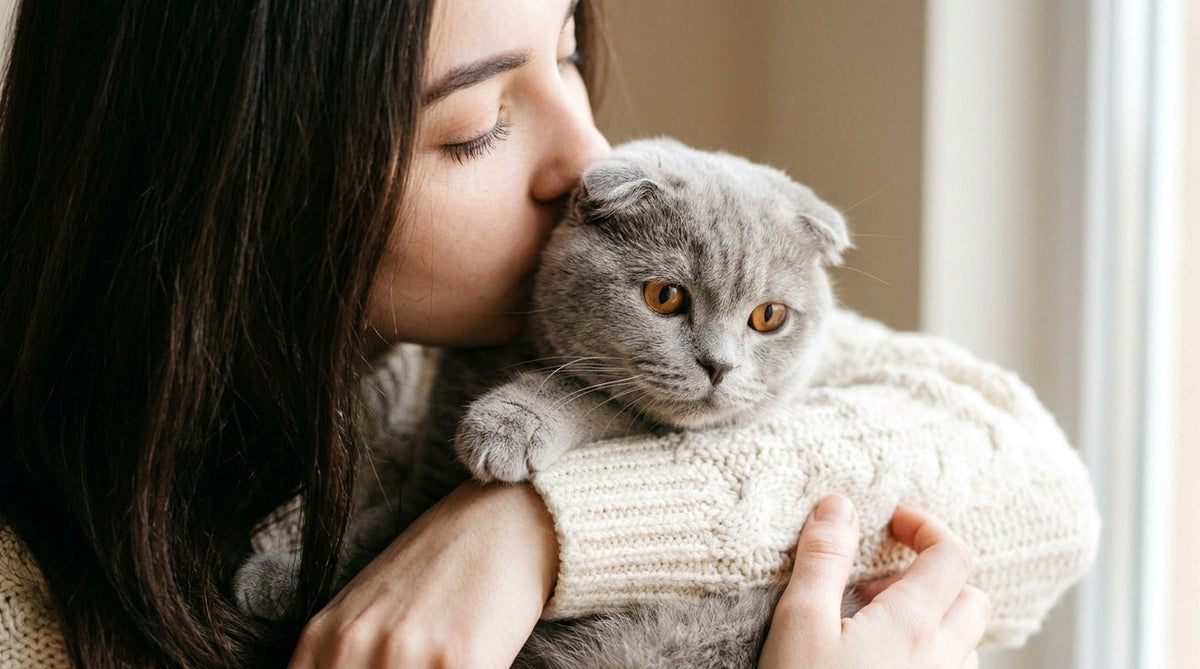
Kissing isn't something cats do with each other, so your cat has no concept of it. A kiss on the head gets translated into gestures it already knows, mainly face rubbing and grooming.
That's why one day your cat leans into a kiss and the next day it strolls off. The kisser matters too. Many cats happily accept affection from their owner yet duck away from a guest, and the tone you use plays a big role.
This article covers how to read whether your cat likes being kissed and which parts of the head are safest. There's also a gesture cats grasp much better than kissing: the slow blink they share among themselves.
How a Cat Decodes Your Kiss
Since kissing isn't part of feline language, cats file it under the nearest familiar behavior. That's why reactions vary so widely between individuals.
It Feels Like Head Rubbing or Grooming
Friendly cats rub their faces together and lick each other.
Your lips touch that same region, so to your cat a kiss resembles a bunt or an affectionate lick.
Bunting uses glands on the temples and cheeks; some people call it headbutting. Each rub blends two cats' odors into a common colony scent.
Licking completes that bond. Cats on good terms groom spots their partner can't reach alone, chiefly the neck and head.
Your Tone Tells the Story
How you sound matters more than the kiss itself. A study in Animal Cognition showed that cats reacted to cat-directed speech from their owner, yet showed no such change when an unfamiliar person said the same phrases.
Many cats also treat their human as a secure base, which explains why a kiss from you may be welcome while an identical one from a visitor is not.
Your cat recognizes you, and the kiss borrows its meaning from that relationship. Speak quietly and softly, then finish with a gentle stroke down the cheek.
Early Handling Shapes Acceptance
Tolerance for a nearby face develops in kittenhood. Kittens gently handled by several people in their first two months typically grow into cats that enjoy human contact.
One handled by a single person may attach strongly to them and stay wary of everyone else. Our article on introducing a new kitten shows that early caution between cats as well.
Do kittens get kisses? They're still learning what a close face means. Brief, gentle moments now shape the adult, and our age conversion guide shows how fast kittenhood passes in human terms.
Adults that missed early handling can still come around. It takes longer, so follow their lead.
Even timid adult cats often start presenting their heads for kisses once they're confident nobody will scoop them up afterward.
Why Cats Come Running to Smooching Sounds
Make a smacking kiss sound across a room and many cats will trot right over.
It's a crisp, high noise cats hear easily, and it usually comes just before attention or a snack.
Your cat links that sound with good things, the same way it learns the meaning of a rustling treat bag. If nothing ever follows, the cat soon ignores it.
To a cat, that call and an actual kiss are unrelated. The noise works at a distance, but up close it pops right next to a sensitive ear, so make face-to-face kisses silent.
Reading Yes and No
Some cats adore being kissed and some merely put up with it. Which you have depends on technique as much as temperament.
Signs Your Cat Welcomes It
Often you'll get a yes before arriving. A vertical tail as your cat approaches and a lifted chin both say it wants closeness.
Once you're near, a willing cat pushes its head into your face. That returned bunt is an unmistakable yes, and coming back for another is even clearer.
Purring is encouraging but not conclusive, because anxious cats purr too, so combine it with other body cues. A brief chirp as you lean closer is usually positive; see our guide to chatty cats for other sounds.
Signs to Back Off
Cats decline subtly, often by turning the head aside while you approach.
Push on and the ears flatten, and a twitching tail soon follows.
These cues are easily missed because cats seldom protest mild discomfort. Owners catch them far more often once they know to watch ear and tail position while the kiss is happening.
Total stillness may just mean coping. Animals that merely endure handling can be more stressed than those who leave, so freezing doesn't equal consent.
Respecting limits keeps everyone safe. A cat pushed too far may nip or swat, and our article on why cats bite explains that warning.
Stop Short and Let Your Cat Finish
Bring your face forward, then pause a hand's width away.
Wait a moment so your cat can choose to close the distance with a sniff or rub.
Rushing in jams your face against its whiskers, frequently paired with a hard stare. Both feel overwhelming, even from a beloved human, and both invade personal space.
That pause even affects hormones. Researchers in a 2026 study with 20 household cats sampled saliva before and after four different kinds of interaction with owners at home.
When owners stayed still and let each cat approach, oxytocin climbed and cortisol, a stress hormone, dropped.
Imposed contact did the opposite.
When your cat leans in, one soft kiss on the crown is enough. For a hesitant cat, a gentle chin scratch carries the same warmth without your face in the way.
Hugs violate this principle because they close the space for the cat. Tight holding can feel like being trapped to an animal that is both predator and prey, so invite a hug-averse cat to sit beside you instead.
When a Kiss-Lover Starts Avoiding Them
Occasionally a cat that always enjoyed kisses begins avoiding them.
Changing reactions to touch in a friendly cat are often among the earliest indications of pain.
Head pain is easy to miss even for attentive owners. Gum disease is very common in adults, ear infections make one side tender, and neck stiffness can cause a cat to dodge reaching hands.
Look for pawing at the face, head shaking or chewing on only one side. If any of these come with a new dislike of kisses, book a vet visit rather than chalking it up to mood.
Sudden touch sensitivity deserves prompt attention, and only a veterinarian can properly examine ears and mouth.
Where to Kiss, and Where Not To
Beyond the top of the head, most cats accept a face near the cheeks or the area between the eyes and ears. Keep hands well clear of the tail base, which is a common trigger for irritation.
Put simply: temples, cheeks and chin are welcome zones; the tail base is not.
Mouths are another story. Feline saliva carries bacteria that can cause illness in people if it enters a cut or sore, although most cat owners never experience problems.
Skip kisses when either of you is sick and wash up after being licked. Take more care with kittens or hunting cats, and if your immunity is weakened, keep licks off your face entirely.
Products on your skin matter too, since cats groom off whatever gets onto their coat. An August 2026 review of minoxidil toxicity in pets listed licking a person's recently treated beard or scalp as an exposure route, and tiny doses of this hair-regrowth drug can be dangerous.
Treat medicated creams the same way: keep your cat off treated skin until it has dried or been washed.
Slow Blinks: Affection in Cat Language
Cats understand slow blinking much better than kissing because they do it themselves. Between cats, a long unbroken stare signals a challenge, and a slow blink softens that into trust and affection.
Replying in feline terms is easy. Researcher Karen McComb recommends narrowing your eyes as if smiling contentedly, then shutting them for two or so seconds.
In her experiments, cats narrowed their eyes in return and approached people who had blinked at them more readily. Try it while your cat relaxes on a nearby chair. If it blinks back, you've just received the feline version of a kiss.
Lying pressed against your leg is another such signal, just as one cat would snuggle against a friend to show total relaxation. Kneading on your lap is part of that family too, covered in our article on kneading behavior.
A Comfortable Drink for a Sensitive Face
Your cat's face meets its water several times daily, and a cat that's at ease there drinks more.
A broad, open bowl means that face never has to cram into a tight space, and a pump under 25 dB is far gentler than a smack beside the ear. The Wireless Cat Fountain 2.0 is built from 304 food-grade stainless steel with activated carbon filtration.
Reading facial cues is the key to a welcome kiss, and it works at the water bowl as well, so watch whether your cat drinks without pausing. You might also like our Wireless Stainless Steel Cat Fountain.