







September 29, 2026
Cat Years To Human Years For A Cat With No Papers
Use the conversion table below and you'll have your cat's age in human terms within seconds.
We also walk through how vets estimate age when a cat arrives without records, and what to adjust in its care as the years add up.
Converting Your Cat's Age
Dogs need different charts for different sizes, but cats don't. Breed makes little difference to how fast they age, so a Bengal and a household moggy share the same numbers.
According to the AVMA, year one equals fifteen human years and year two adds nine, so a two-year-old cat is about twenty-four. From there, add four for each birthday.
| Age of cat (years) | Human equivalent |
|---|---|
| 1 | 15 |
| 2 | 24 |
| 3 | 28 |
| 4 | 32 |
| 5 | 36 |
| 6 | 40 |
| 7 | 44 |
| 8 | 48 |
| 9 | 52 |
| 10 | 56 |
| 11 | 60 |
| 12 | 64 |
| 13 | 68 |
| 14 | 72 |
| 15 | 76 |
| 16 | 80 |
| 17 | 84 |
| 18 | 88 |
| 19 | 92 |
| 20 | 96 |
What most charts don't mention: this scheme is an agreed convention, and it started with dogs. Lebeau proposed it in 1953, arguing that a fixed multiplier fails because aging speeds and slows across a lifetime.
The feline version borrowed that dog curve afterward, with 15 and 24 layered on as veterinary custom. Nobody has validated it for cats with the rigor those tidy figures imply.
It's still useful, and it beats the old "times seven" rule easily. Just treat it as an approximation that looks more exact than it is.
The trouble is how it's presented. Printed without context, a chart looks like hard data, and nobody can tell the figures were adapted from another species decades ago.
How Vets Estimate Age Without Records
For a cat with an unknown past, age comes from a physical exam. The vet reasons backward from what they can see and feel, and each clue is dependable during a different life stage.
Kitten Teeth Give Precise Answers
Kittens develop on a predictable timetable, so early months are easy to read. Teeth are the best guide here. Baby teeth erupt at three to four weeks and are all in by six to seven weeks. They start falling out near three months, and by six or seven months the cat has its 30 permanent teeth.
During that stretch a vet can usually estimate within roughly two weeks, which is about as precise as cat aging ever gets.
After That, Expect a Two-Year Margin
Once the permanent teeth are in, the timetable is over. Vets then judge wear and tartar, and the honest error margin grows to a year or two, widening further in older cats.
Charts never print that uncertainty beside their neat conversions. A vet saying "roughly six" usually means five to seven.
A Hard Outdoor Life Skews the Estimate Upward
The error tends to run one way. A cat that has survived outdoors can show the dental wear of a much older animal, so its estimate comes out too high.
Underestimates are far less common. When a stray's mouth looks rough, muscle tone and coat quality are what nudge the guess back toward reality.
Muscle Condition Declines After About Ten
A second, scored tool exists alongside teeth. Vets frequently use the WSAVA (World Small Animal Veterinary Association) muscle condition chart to assess age-related muscle wasting. In the Cat Prospective Ageing and Welfare Study from the University of Liverpool, published in Frontiers in Veterinary Science, researchers followed 209 pet cats for up to seven years.
Scored across ten skeletal landmarks for a maximum of thirty points, the cats averaged 30.0 at seven years old, 27.7 at ten and just 14.5 by sixteen. After roughly ten and a half, mild muscle loss was more probable than none.
That's why your vet runs their hands over the backbone and shoulder blades before naming an age.
DNA Tests Are Emerging
Physical clues only go so far, and lab science is starting to go further. Raj and colleagues developed DNA methylation clocks for cats, one of which works from a blood sample alone.
For now this belongs in research labs rather than clinics. It measures age directly from genetic material, a fundamentally different kind of evidence from a hands-on exam.
Is the Age on Your Cat's File Accurate?
If you adopted from a rescue, the age in your cat's records was estimated the same way, usually in less time and with zero background.
Shelters Work Fast
Most shelters judge teeth, coat and behavior, often on intake day and often in a few minutes. It's a sensible quick guess that becomes a fixed number because paperwork demands one.
Mistakes Surface Much Later
Corrections tend to arrive years afterward, and usually by a lot. A cat listed as three that a careful exam later puts closer to seven is a familiar scenario.
It typically comes out during a visit for something unrelated, by which point age-appropriate screening may be two or three years behind.
Some cats remove the main clue entirely: many lose most or all their teeth by age two or three, and then dental aging is impossible.
Charts Disagree With Each Other
So the recorded age is uncertain, and so is the conversion. Chewy's chart sits consistently above the standard model and is seven human years higher by the time a cat reaches sixteen.
The differences start early. Chewy equates a one-year-old cat to a human of 13 to 15, where the usual model says simply 15, and DailyPaws and Adopt a Pet both put a two-year-old at 25.
Middle Age Isn't Old Age
The uncertainty matters because of what people conclude from the number. Calling a six-year-old cat a forty-something human makes it feel like time is running out, and it isn't.
Cats Can Pass Twenty-Six
Average lifespans understate how long your own cat may live, because they're dragged down by every cat lost young. Your cat has already cleared that hurdle.
Look at the upper end. Documented maximums are much higher than most people guess. Guinness World Records verified a cat named Flossie as the oldest living at 26 years and 316 days, and vets routinely treat cats in their twenties.
Older Adoptees Have Advantages
Adopting at six or seven has medical perks people rarely mention. The cat has outgrown the age when FIP and FeLV most often strike, is already desexed, and has a known track record with anesthesia.
Many who adopt at that age find their cat still vigorous at eleven, with another decade likely ahead.
Passing on an older cat purely because of arithmetic is a real loss, and the number shouldn't be the deciding factor.
How Care Changes Past Ten
An age estimate only matters if it changes what you do. It changes two things, both aimed at spotting problems while they're still cheap and simple to treat.
Checkups Become Twice as Frequent
Under the life stage guidelines from AAHA and AAFP, cats count as mature from seven and senior from ten. AAFP's senior care guidance then calls for exams at least twice a year between ten and fifteen, and three times a year after fifteen.
If the file understates your cat's age by two years, that schedule kicks in two years too late, which is the practical cost of a fuzzy number.
At your next appointment, request the vet's own age estimate and note the whole range, then schedule screening around it.
Blood Tests Catch Kidney Changes Early
Kidney decline is the most predictable companion of aging. Cornell's Feline Health Center puts it at as many as 40% of cats past ten and 80% past fifteen. Combine that with a two-year error and a cat recorded as nine but really eleven has crossed the first threshold without a single outward sign.
Catching it early depends on which marker is tested, and in a lean senior the usual one can mislead. SDMA climbs before creatinine. IRIS staging treats SDMA up to 14 ug/dL as normal, while a persistent 15 to 17 ug/dL suggests Stage 1 even when creatinine still looks fine.
Persistence is key: retest after several weeks before acting on one high value. Thin seniors lose muscle, and since creatinine depends on muscle mass, it understates kidney trouble exactly when accuracy matters most.
Hydration: The Easiest Thing You Can Do
All the testing happens at the clinic. At home, your biggest lever is water intake.
Watch any cat at a running tap and you'll see why. Many will bypass a full bowl to drink from a faucet, which is why Cornell's kidney advice even mentions fountains.
Bowl design counts as much as freshness. Whiskers hitting the walls of a narrow, deep dish is a minor daily irritation, and such irritations decide whether a lukewarm drinker becomes a steady one. That's the heart of the fountain versus bowl debate.
| Feature for seniors | Benefit |
|---|---|
| Faucet-like stream | Appeals to the natural pull toward flowing water |
| Broad, shallow basin | More comfortable than a narrow, deep dish |
| Stainless steel build | Stands up to scratches and pits where biofilm hides |
If your cat's records are two years off, habits meant to start at eleven should have begun at nine, and there's no rewinding. Building good hydration habits today is the next best step. Our Wireless Cat Fountain 2.0 uses 304 food-grade stainless steel, activated carbon filtration and a pump under 25 dB.
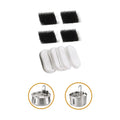
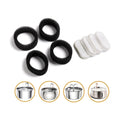
Any fountain still needs regular washing, just like food bowls; ours cleans in under 5 minutes with dishwasher-safe stainless parts, and fresh replacement filters keep it performing well.