







September 29, 2026
Why Does My Cat Bite Me? A Guide to Fewer Bites
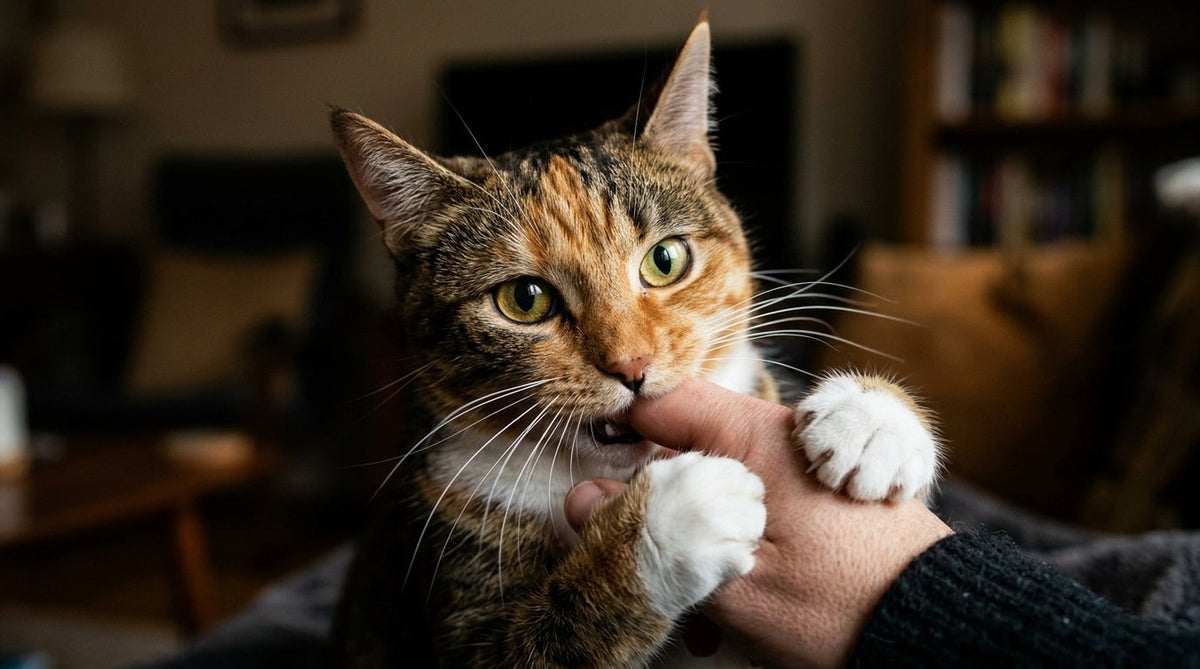
Getting bitten by the pet you shower with love never feels good. The key thing to understand is that a bite is rarely true aggression; it's your cat communicating in the only way that seems to work.
This guide explains why cats bite the people they live with and how to prevent repeat bites in a way that's safe for you both.
The Five Main Causes
When owners wonder why their cat bites, they usually want one explanation, and nearly every bite traces back to one of the five causes below.
1. Contact Your Cat Didn't Want
Stroking, brushing or lifting a cat is the most frequent trigger for bites directed at owners.
Petting is what we do most, and it's easy to miss the moment your cat has had her fill, which is when teeth come out. Partly that's overstimulation; partly it's your cat deciding when contact stops.
Importantly, she isn't rejecting touch altogether. She's rejecting it at this particular moment, and she's used up her gentler ways of telling you.
2. Play Biting Gets Worse When You Yank Away
Snatch your hand back and your cat chases it, because a fast-retreating hand resembles fleeing prey.
One bite followed by instant calm once your hand is out of reach points to overstimulation. Ears pinned back and a renewed attack at the next opportunity points to play.
A 2026 survey of 462 homes found owners with just one cat reported aggression toward humans considerably more often than multi-cat owners.
The reason: a single cat without a feline sparring partner has only one playmate available, and that's you.
3. Gentle Nibbles Are Bids for Attention
Lacking hands, cats lean on their mouths to communicate. A soft nibble that doesn't break skin usually means your cat wants contact or wants you to notice her.
4. "Out of Nowhere" Usually Means a Missed Trigger
Bites that seem unprovoked are typically redirected aggression, and they feel random because of when they happen.
Something upset your cat that she couldn't get to, so the frustration landed on you. A sudden noise or a run-in with another animal is a common spark, and instinct takes over.
Sometimes a few minutes apart is enough, though VCA notes it can take hours or even days before such a cat is calm enough to approach safely.
People call it the bite that came from nowhere, but if you retrace events there's nearly always a trigger.
5. New Biting Signals Pain Until Ruled Out
The most worrying case is an older cat that always accepted handling and has only lately started biting.
Check for medical causes first. A hurting cat will lash out to avoid being touched or moved.
If you can do so gently, look your cat over for lumps, bruises, wounds or signs of infection.
Reducing the Bites
Once you've identified the cause, you can respond appropriately. Each cause calls for a different approach, covered below.
Punishment Makes Bites Worse
Cats followed from kittenhood to adulthood showed more serious aggression toward people when owners used punishment, whether shouting, scruffing, spray bottles or nose taps. Physical correction increases fear, which is exactly what you want to remove.
That's logical given why she bit. She wanted to end an interaction; adding fear simply gives her more reason to end it sooner next time.
Say "Ouch," Then Leave
Kittens learn to soften their bite because play ends when they're too rough. Recreate that: make a brief, sharp pained sound, then stand up and leave the room silently.
Watch for warnings that come before the teeth. An irritated or overstimulated cat shows dilated pupils, ears turning backward and a twitching or thrashing tail, and some place their teeth on you as a warning first. A few show skin rippling along the spine. Step away at any of these signs and the bite never happens. Afterward, offer a wand toy if she still wants to play.
Order beats intensity: signal, exit, redirect.
Let Her Initiate, and Pet the Face
First, consider who starts the interaction. Biting persists because it succeeds: it ends contact every time, and successful behavior gets repeated.
Remove the payoff, which is easier than it sounds. Keep petting short and let her begin it, so biting no longer gains her anything. Shelter cats given this exact approach stopped biting and found homes.
Second, think about where you touch. Cats welcome contact on the chin, muzzle and cheeks, home to scent glands they like to rub. The belly, by contrast, is protected reflexively, and no patience will change that.
That's the core mismatch: people tend to stroke the areas they find pleasant, often the back and tummy. Your preferences differ from your cat's, and hers determine whether you get bitten.
It May Get Worse Before It Gets Better
When a behavior that always worked suddenly stops working, it often intensifies before disappearing, something behaviorists call an extinction burst. Plan on about two weeks of this, and remember that it feels like failure but actually shows the method is taking hold.
Keep a simple tally on your phone. Memory is unreliable, and written notes will reveal the trend when your patience wears thin.
Relocate Bowls Away From Food and Appliances
Here's the part people skip. Each cat has a daily tolerance for handling, and a cat that spends the day slightly on edge starts every interaction with less of it. The placement of her resources affects how much tolerance remains when you reach out.
Veterinary guidance on home setup is straightforward: food, water, litter and resting spots each belong in a distinct location. She shouldn't have to meet two needs in the same place, since that's a common source of household tension.
Most homes fall short. A 2025 Veterinary Record survey of 565 UK households found 67.1% placed water within sight of the cat's food, and 30.4% kept bowls within 50cm of a dishwasher or washing machine. Two-thirds of those homes reported some behavior problem, and biting is among the behaviors that ease when those stressors disappear.
Picture it in terms of moments. Count how often she drinks each day; every sip next to a rumbling washer is a small alarm she can't ignore, and by evening they've drained her patience for your hands. If she's stopped drinking altogether, read our article on cats that quit drinking.
Our fountain versus bowl comparison covers setup. Moving water to a quiet spot is free and worth doing first, because environmental changes help aggressive cats more than relaxed ones. The cat who bites has the most to gain.
Will My Cat Outgrow Biting?
Usually yes, and even when not entirely, it changes. Since this is the question beneath all the others, here's a direct answer.
Biting Peaks Between Six Months and Two Years
Kittens bite while learning hunting skills, from about eight weeks to six or seven months. Adolescence follows, somewhere between six months and two years.
Many cats get worse before they improve, for a developmental reason: drive matures before self-control does, so an adolescent wants more and holds back less.
If your nine-month-old seems harder than she was as a kitten, you're likely at the toughest point of that curve, not looking at a permanent personality.
Adult Cats Can Still Change
Owners of grown cats often fear it's too late.
Biting has several contributing factors: genetics, early experiences, environment and handling. Two of those you can influence at any age.
The shelter cats mentioned earlier were adults whose biting kept them from being adopted, and all of them improved. Age made progress slower but didn't block it, which is the most valuable thing to know if you've concluded your cat will always be this way.
The worry is understandable. One owner on r/CatAdvice described dreading time with her five-year-old cat because she constantly expected a bite, and feared it was too late to change. It isn't; it just takes longer and demands more consistency than it would have at eight months.
Early Weaning Affects Reactions to Strangers
Weaning age does matter: kittens removed from the litter before eight weeks show more adult behavior problems than those kept until twelve or thirteen weeks.
But where it shows matters more than how much. The effect appears in how cats treat unfamiliar people, with no measurable difference toward their own household. So while early weaning is real, it probably doesn't explain bites aimed at you, a family member.
"Single kitten syndrome" deserves less weight than its reputation. The evidence is thin; what holds up is personality, environment and how you respond, and two of those are still yours to shape.
When a Bite Breaks the Skin
This section is about your health, not your cat's behavior. If a bite punctured your skin, tend to the wound first, because cat bites are far more dangerous than their size suggests.
Puncture Wounds Trap Bacteria
Cat teeth are slender and needle-sharp, so they puncture rather than tear, pushing bacteria deep and leaving a tiny hole that seals over them.
Such wounds can't drain. Bacteria stay trapped beneath already-closed skin, which is why the bite that looks harmless so often becomes the problem.
Seek Care Within Eight Hours
Emergency medicine sources estimate that 20% to 80% of reported cat bites become infected and advise seeing a doctor within eight hours for any bite that breaks skin. Dog bites fall well below that range, a useful contrast: the wound people worry about less is the one more likely to get infected.
Delay lets bacteria take hold, and in a sealed puncture they can only spread inward.
Have it checked the same day, and sooner if you're diabetic or immunocompromised, if the cat's vaccination history is unknown, or if your last tetanus shot was over five years ago. A doctor should decide on antibiotics or a booster.
Hand Bites Often Mean Hospital Stays
Location matters more than appearance. Trauma surgeons studying 102 adults treated for cat bites on the hand and forearm found bacterial growth in 61%, with Pasteurella multocida responsible for 53% of positive cultures, and an average hospital stay of 3.1 days.
Tendon sheaths and joints lie just beneath the skin of the hand. A puncture that reaches them creates pockets that are hard to clean, so any hand or wrist bite that breaks skin deserves same-day care, however small it looks.
A Calmer Spot for Water
Everyone agrees resources should be separated, but arranging it is tricky because bowls end up wherever there's an outlet or empty corner. That's why the advice often goes unheeded. The same UK survey found just 19.1% of homes used a cat water fountain at all.
A cordless fountain such as our Wireless Cat Fountain 2.0 removes the outlet problem, so water can go wherever your cat feels calmest. That's the gap between knowing where her water belongs and actually putting it there.
The goal here is location, not volume.
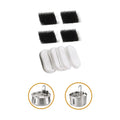
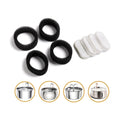
Placement is only half the story, since a loud fountain would spoil the quiet corner you chose. Its pump runs under 25 dB, so the calm spot stays calm, and the wide, shallow basin keeps whiskers clear of the sides. It's made from 304 food-grade stainless steel with activated carbon filtration.
Give her water a peaceful corner of its own, away from food and noise.
If the biting started suddenly or your cat is aging, see your vet before trying anything else. Pain must be ruled out first, and a vet can examine her in ways an article cannot.