




September 29, 2026
A Guide To Cat Panting In Every Scenario
If your cat is laboring to breathe, don't wait and watch. Contact a veterinarian right away, and come back to this article later.
For everything else, it helps to understand how panting really works in cats, because it differs from what most people expect. Dogs pant as their main cooling system. Cats mostly release heat by licking their fur so the saliva evaporates, and by widening the blood vessels near the skin so warmth escapes.
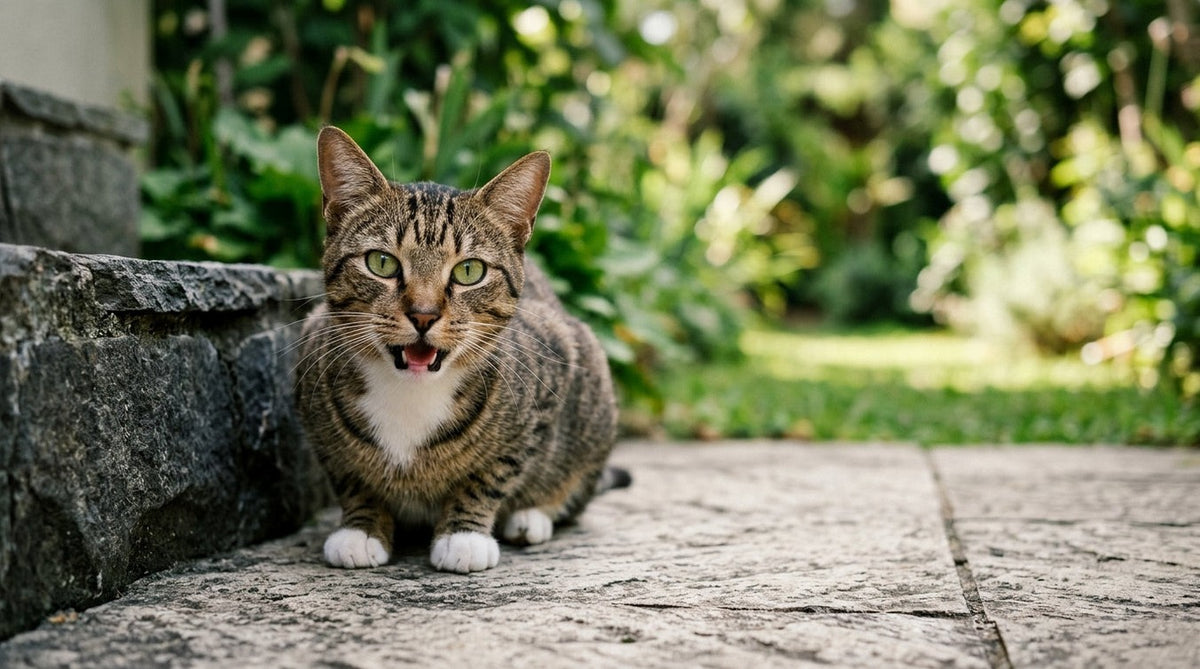
Open-mouth breathing only begins once those systems are maxed out. That's the key point: because panting sits at the end of the line, a panting cat is always telling you it has hit some kind of ceiling.
So the useful question is which ceiling. There are three common, ordinary causes and one that calls for picking up the phone, and we'll cover them starting with the situations owners run into most.
Breathing Hard After a Play Session
After vigorous play, your cat is repaying an oxygen debt. It dashed around, its muscles demanded more oxygen than its lungs could keep up with, and now its breathing is catching up. A healthy cat recovers within about a minute or two of stopping.
Panting that fades this quickly is the least concerning type. It happens easily because cats simply aren't endurance athletes. International Cat Care's advice on play describes them as short-burst sprinters and says that a single minute of wild activity counts as a successful session.
Take that literally. A minute is a complete workout by feline standards, which puts most play-related panting in perspective.
If your cat was panting after a twenty-minute wand-toy marathon, fitness wasn't the issue. It was kept going roughly twenty times longer than its body is designed for. Kittens especially will play to exhaustion, because their excitement outlasts their stamina.
Often the cat keeps going because the game never gave it an ending. Hunting concludes with a capture, and a laser dot can't be captured, so there's no natural signal to stop.
Research supports this. In an online survey of 618 owners, Lori Kogan and Emma Grigg found that laser play was linked with repetitive, compulsive-like behaviors. They pointed to the missing finale: with a laser alone, cats never get to finish the hunt.
The same study found those behaviors were more likely in indoor-only cats and in cats aged one to two. That describes many of the cats whose owners end up worried about panting.
You also can't assume you'll recognize when your cat has had enough. Julia Henning and colleagues at the University of Adelaide analyzed eleven online videos showing cats clearly objecting during play, reviewing the first hundred comments on each. Positive comments ranged from 75 percent to 93 percent depending on the video. People watched a cat refusing and saw a cat having fun.
The fix is simple and free.
| Step | Reason |
|---|---|
| Time a normal session first | Learn your individual cat's limit rather than relying on averages |
| End about a minute before that | Panting signals the limit has been reached |
| Close with a catchable toy | A capture completes the hunt and gives the chase an ending |
Love the laser? Keep it, but finish by dropping a real toy into the beam so your cat ends with a genuine catch. And if four minutes leads to panting, cap sessions at three.
When Hot Weather Is the Cause
Heat is the second ceiling, and it comes with a clear danger line.
With very few sweat glands, cats depend on evaporation to cool off, and hot weather undermines exactly that. When the air gets warm enough that saliva can't evaporate well, body heat has nowhere to go, and overheating develops fast.
Body temperature is what separates discomfort from emergency, so it pays to know the numbers. Veterinarian Lisa Goldstein outlines them in a heatstroke article for Preventive Vet, and one of them is surprisingly tight.
| Measure | Value |
|---|---|
| Typical feline body temperature | 99–102 °F |
| Heatstroke threshold | Over 104 °F |
| Mouth-open breathing that can indicate early heat exhaustion | Continuing past 10–30 seconds |
Ten to thirty seconds isn't long, and two kinds of cats have even less margin.
Flat-faced breeds take in less air per breath, so watch them closely when temperatures climb. In a 2026 paper in the journal Animals, researchers measured breathing in 43 household cats using a sealed chamber for precise readings. Brachycephalic, or flat-faced, cats moved significantly less air per kilogram of body weight than cats with standard muzzles.
Excess weight is the second risk. Fat acts as insulation on a cat already struggling to lose heat, and it makes every movement harder. Heavier cats start panting noticeably sooner.
On a hot day, keep it simple:
- Bring your cat into a cooler room with a breeze
- Offer a drink from a bowl or a stainless steel cat fountain
- Give it space to recover without being picked up
These matter more than they seem. Don't dunk an overheated cat in cold water; that constricts the vessels near the skin and seals heat inside. Gentle moving air helps the cooling your cat is already attempting. A cat that has quit drinking also has less saliva to work with.
Panting During Car Rides
Exercise and heat leave obvious clues. Stress leaves none, which is why car trips surprise so many owners.
The giveaway is that stress panting starts with no physical effort. Nothing was chased and the car is cool, but your cat is breathing fast through an open mouth, and resting won't help because it's already resting.
| Cause | Trigger | Resolution |
|---|---|---|
| Play | A dash the cat couldn't end | A short rest |
| Heat | Evaporative cooling falling short | Cooler air, possibly a vet visit |
| Stress | No physical cause | Arriving back home |
Anxiety raises the heart rate, and a racing heart needs oxygen delivered faster. Mouth breathing is one of a cat's few tools for moving more air fast, the same mechanism you see after sprinting, just triggered inside a carrier.
Carrier panting typically stops after arrival. Longer trips are worth planning for carefully. The real hazard is the combination: an anxious cat is already breathing heavily, and a stationary car warms up shockingly fast.
Shade and lowered windows alone won't keep a parked car safe.
Two cats crammed into one carrier also block each other's airflow, so use separate carriers. And never leave a cat alone in a parked car, however briefly and however shady the spot.
Labored Breathing Means a Same-Day Vet Call
Rule out play, heat and stress, and one scenario is left: no exertion, no warm air, nothing frightening, yet the mouth stays open. Your vet needs to hear about that today.
At that stage it isn't really panting anymore, and once you know the signs you can tell the difference from across the room.
Panting is rapid and shallow while the cat otherwise looks calm. Labored breathing recruits the whole body. Look for:
- The belly heaving with each breath
- The neck stretched forward and elbows splayed outward
- The cat sitting upright because lying flat makes it harder
Pale or bluish gums remove any doubt. That's an emergency.
Before you phone, spend fifteen seconds getting a breathing count, since a vague description is hard to act on remotely. The approach follows VCA's guide to checking breathing rate at home, and the PDSA recommends the same: count while your pet sleeps or rests calmly, not mid-dream, for fifteen seconds, then multiply by four.
| Question | Answer |
|---|---|
| Best time | During sleep or calm rest, never while purring |
| Method | Each rise and fall of the chest is one breath; count 15 seconds and multiply by 4 |
| Healthy range | 15–30 breaths a minute |
| When to phone | Repeatedly over 30 |
Heart specialists rely heavily on this resting rate. A gradually rising count is one of the earliest warnings of heart trouble.
Owners usually fear one of two conditions. Asthma is the first, but diagnosed cases are mostly middle-aged cats, so a kitten racing through the hallway doesn't fit the typical profile.
Heart disease is the second, and it warrants more concern. The CatScan project examined 780 seemingly healthy shelter cats and detected hypertrophic cardiomyopathy in 14.7 percent, about one in seven. The worry is well founded.
Also shoot a short video. These episodes rarely happen at the clinic, and half a minute of footage is worth far more than a long verbal account.
Take the video and the breath count to the appointment, and mention any other recent changes, including when your cat last had a drink.