







January 23, 2023
Top 7 Reasons Your Cat Bites You Unprovoked
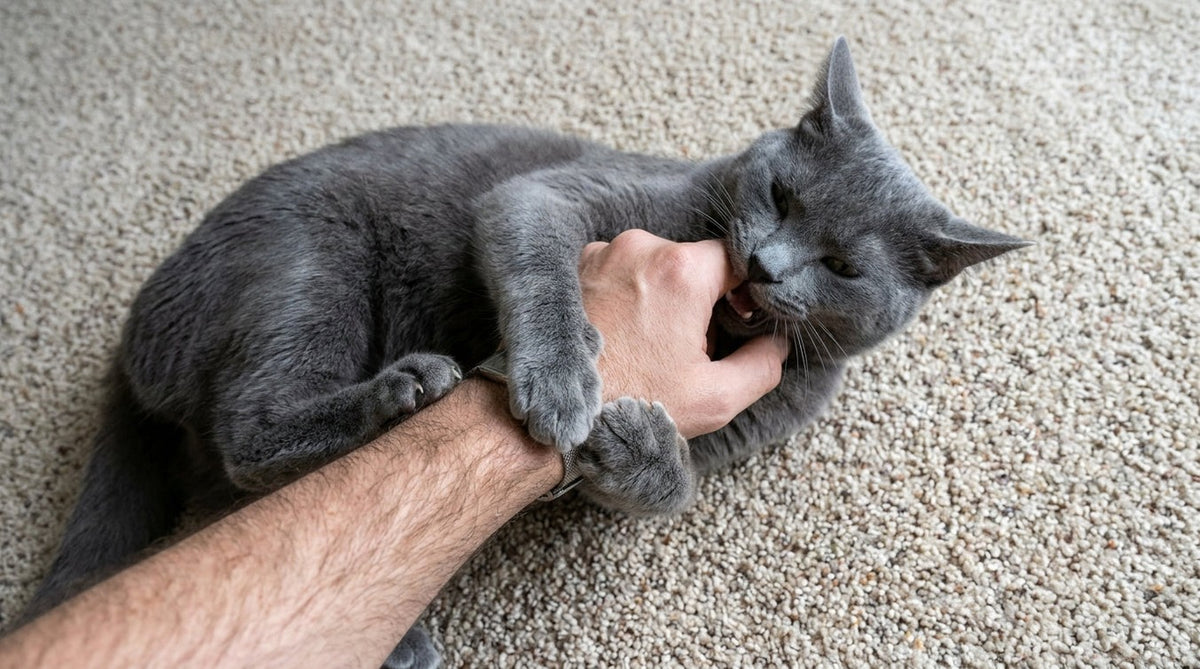
A bite that seems to come out of nowhere can be frightening and even risky, but understanding why it happens is one of the best ways to protect yourself.
Before we go through the reasons, please remember to treat every cat bite seriously and stay cautious. Cat bites frequently become infected and may need oral or IV antibiotics, and in some cases surgery.
If your cat keeps biting you for no obvious reason, something underneath may need attention. Here are the top 7 reasons a cat may bite unprovoked:
1. Redirected Aggression
Redirected aggression happens when a cat unloads its frustration on someone who did not cause it.
What makes it tricky is that it can show up a good while after the event that sparked it, so pinpointing the trigger is not always easy. A very common trigger is a cat spotted outdoors that your cat cannot get to. Your cat may then lash out at any other pet or person in the house.
If something outside sets your cat off, try blocking their view so they cannot see what upsets them.
In multi-cat homes, redirected aggression can also start when one cat is triggered by another. In that case, the best approach is to separate the cats and reintroduce them slowly.
2. Overstimulation
Experts do not fully understand overstimulation in cats, but it is definitely real. It can happen during play, most often with people or other cats and occasionally with objects, and it can also happen during affection. There are a few possible explanations.
When cats play, they often act out the exact steps of a hunt: stalking, pouncing, catching, and "killing" their prey. Playtime mirrors all of those behaviors.
Because a hunt ends either in a big payoff or in plenty of frustration when the prey escapes, the brain may shift into high gear and leave the cat extremely wound up, much like we get when something exciting or irritating happens.
Play may trigger the same response. When you see your cat getting overexcited, redirect them by tossing a toy or switching on an automatic toy such as the Smart Interactive Cat Ball, then step away.
If cats get overstimulated while playing with each other, use a blanket or towel to separate them. Never use your hands to break up a cat fight.
Petting opens up other possibilities. Cats often get overstimulated when they are stroked from head to tail again and again. That repeated stimulation can rev up the brain until their energy spills over into a nip or bite.
It is also possible that your cat gave a subtle signal asking you to stop, the signal went unnoticed, and a bite followed.
Keep petting sessions short, focus on the head, and limit head-to-tail strokes to just a few before stopping.
3. Playfulness
Biting is a normal part of play. Cats chomp on toy mice, streamers, kicker toys, and fuzzy balls just as they would on real prey.
During play, keep your hands and feet out of reach and leave some space so your cat sinks their teeth into the toy instead of you.
Kittens are known for wrestling with hands and nibbling fingers. It is sweet when they are tiny but becomes a problem once they are grown, which is why experts advise against using your hands as toys.
4. Scared or Startled
A frightened or startled cat may bite to protect itself or to drive away whatever is scaring it.
Most cats would rather avoid conflict, so they use warning swats and bites first. When startled, they react a lot like we do and may overreact with a bite.
To keep yourself safe, give a scared or just-startled cat some space. That gives them a chance to size up the situation and, ideally, calm down.
5. Attention
Cats quickly learn that misbehaving gets our attention, and if we are not careful, it can turn into a habit.
A cat might rub against you looking for attention, and you do not respond. Then they paw at you, and you still do not respond. It is easy to see how some cats end up nipping or biting because nothing else worked.
To head off biting, play with your cat every day and give them lots of attention. For cats that crave attention but get overstimulated easily, stick to two or three strokes and then stop.
6. Pain
A sudden personality change in a cat very often points to pain. Even the sweetest cat can become snappy almost instantly when something hurts.
Cats are experts at hiding discomfort, because in the wild any sign of weakness is dangerous. Pain is hard to spot, but careful observation may help you catch something unusual.
Pay attention to how your cat moves. Less activity or a changed gait could mean they are hurting.
Watch for shifts in litter box and eating habits, which may suggest a digestive problem or even dental disease. Also notice how they respond to petting.
Do they seem fine until your hand gets near one particular spot? Are they a senior cat? Joint pain could be the cause.
Even if you cannot find anything specific but your cat keeps lashing out, talk to your vet and share your concerns.
7. Lacks Proper Human Social Skills
Kittens go through critical developmental windows, and socialization is one of them. Early socialization runs from about 3-7 weeks, and late socialization continues until 16 weeks.
Along with learning from their mother and littermates, this is when kittens should get used to people.
Kittens separated too early from their mother or littermates may miss out on proper socialization. Some grow up without healthy boundaries with other cats, particularly if they were raised only around humans.
On the flip side, kittens with little early human contact may be afraid of people or treat them as if they were other cats.
Socializing an adult cat with people is harder, but it is sometimes possible. Set clear boundaries and choose play that keeps a bit of distance between you and your cat. Wand toys and automatic toys work very well for this.
Conclusion
Keep in mind that cat bites can be dangerous and can spread disease, so tackle the problem as soon as you can. If your cat bites you without provocation, consult a veterinarian or a professional animal behaviorist to find the cause and the right solution.
What Your Cat Needs
Give your cat a safe outlet for hunting energy with the Smart Interactive Cat Ball, and support a calm daily routine with the Automatic Smart Cat Feeder and the 2.2L Stainless Steel Cat Fountain.