








July 21, 2026
The 60-Second Test That Tells You If Your Indoor Cat Is Happy
Has your cat ever glowered down at you from a high shelf, leaving you to wonder what you got wrong? Relax. Contentment in an indoor cat shows up more quietly than people imagine, it lives mostly in posture and expression, and sixty seconds is enough to check it.
Lots of cat owners share this worry. This is not a lecture about keeping cats indoors. It is a fast check, followed by some honest reassurance about the behaviors that concern us when they really shouldn't.
For a start, this is roughly what a contented indoor cat looks like:
- Loose, easy posture, a dependable daily rhythm, and approaching you when it feels like it
- Hiding or keeping some distance is usually normal, not a sign of rejection.
- Living indoors can make for a very happy, very safe cat, as long as the home covers what it needs.
- Consistent drinking every day is among the easiest signs of wellbeing for you to encourage.
A One-Minute Contentment Check
Start a timer if you want. You are checking for signals in four areas, and your cat does not need to pass every one. Taken together, these areas give a truer picture of a contented cat than any single cute moment.
1. Posture and body
Begin with posture, because a cat's body tells you a lot. A relaxed cat has soft, forward-facing ears, a loose stance, and a tail that rises when it sees you, often with a little curl at the tip.
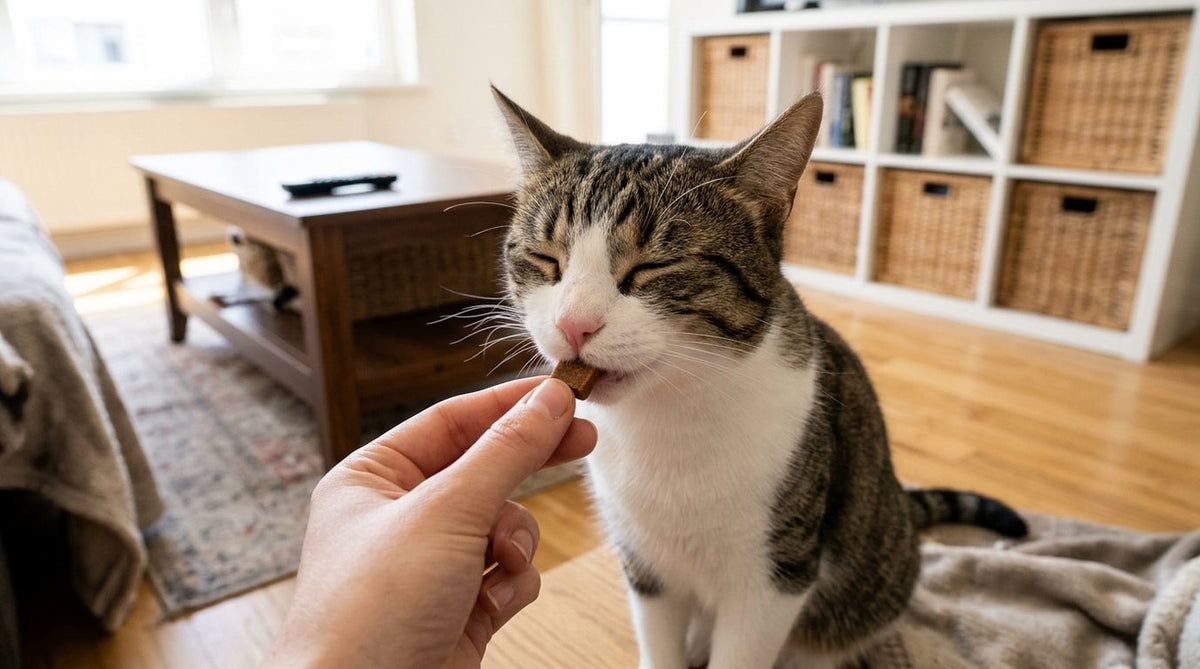
Watch for the slow blink. That sleepy half-closing of the eyes is the nearest thing a cat has to a smile, and a study showed that if you slow-blink at a cat first, it tends to narrow its own eyes back at you.
A self-assured cat may also roll over and show you its belly, although that is not always a request for a tummy rub.
2. Sounds and voice
Next, listen. Purring while you pet your cat or sit together usually signals contentment, but cats also purr to calm themselves, so compare it with the positive body signals above.
A happy cat has plenty of cheerful sounds: chattering at birds outside the window, or a little trill to greet you when you come home.
Chatty meows are usually directed right at you, because cats reserve that kind of conversation for the people they genuinely like. That is an excellent sign.
3. Daily habits
Happy cats love their habits. Eating reliably, grooming as usual, using the litter box normally, and sleeping deeply for long stretches all suggest a cat that feels safe.
Drinking belongs on this list too, and a sudden drop deserves attention, since the reason a cat stops drinking is often something simple, like a bowl in the wrong place.
When any one of those routines shifts sharply and suddenly, take that as a prompt to investigate.
4. How it treats you
Last, pay attention to the way your cat behaves around you. Trailing after you from room to room or rubbing against your legs (called bunting) is genuine affection. Kneading your lap, often called making biscuits, means the same thing.
A cat that keeps you company from the other side of the room, instead of on your lap, is still showing trust in its own understated way.
Reading the results
When most of the four areas check out, your cat is relaxed and content. One pass through them gives you a fair sense of how your cat is doing, without overanalyzing.
One or two missing signs usually reflect personality, not a problem. The cat to watch is one that has suddenly dropped several habits at once, and we will get to that.
Habits That Look Worrying but Usually Aren't
This is where most of the anxiety comes from. Plenty of ordinary cat behavior can feel like a snub if part of you expects dog-style devotion, but a snub is almost never what it is.
Occasional hiding is completely normal
Cats are built to rest in safe, enclosed spots, so an afternoon under the bed is not sulking. If a cat hides all day, day after day, and shows no positive signs at all, that is another matter, but the occasional vanishing act is normal.
A cat that skips your lap still loves you
Plenty of cats express affection by sharing the room with you instead of sitting on you, and a cat napping a few feet away is still choosing your company.
Other behaviors people misinterpret
Skipping the welcome at the door, dozing for most of the day, or racing around at 3am are all just normal cat things.
A light nip during play is communication, not aggression, particularly if it stops the moment you stop.
What truly unsettles cats is sudden change in their surroundings. A predictable world helps most, which is why keeping your cat's routine as steady as possible matters whenever life gets hectic.
Living Indoors Can Be a Great Life for a Cat
If I could talk you out of one thing, it would be the guilt. Indoor cats aren't being denied some superior existence. They avoid traffic, predators and the diseases outdoor cats can catch, which goes a long way toward explaining their longer lifespans.
The real requirement is a home enriched enough for a cat to express natural behavior. Ohio State's Indoor Pet Initiative considers scratching surfaces, perches and toys essential, not optional:
- A cat tree or wall shelves that give vertical space to climb and look out from
- A scratching post for stretching and marking
- Interactive toys, like a Smart Interactive Cat Ball, and daily play that satisfy the hunting drive
- A bit of catnip and a window perch for easy entertainment
- A quiet place to retreat, plus easy access to fresh water
Provide those and you will naturally end up with a lively, inquisitive cat that keeps investigating its territory. Daily play also takes care of exercise, which is especially important inside, where a stray moth may be the only prey around.
Living indoors is not a compromise. If you are setting up a home for a cat from scratch, start with those essentials and build from there.
One honest note
Reassurance only goes so far, and it helps to know where the line is. If your cat abruptly refuses food, disappears for days at a time, or licks a patch of fur away, it is no longer a quirk and deserves a call to the vet. What matters is a sudden break from the way your cat normally behaves, not any one behavior.
A Simple Upgrade: Water Your Cat Wants to Drink
If there is one happiness signal you can actively improve, it is drinking. Plenty of cats stroll past a bowl filled to the brim, yet cats that drink well tend to be relaxed and to age in better health.
A truly relaxed cat is easy to recognize: comfortable sprawls, slow blinks, an unhurried stroll around its territory. That kind of ease grows when daily basics are taken care of without fuss.
A healthy cat shows it in small details, from bright eyes to a shiny coat and steady energy. Good hydration quietly supports much of that. See how the Wireless Cat Fountain 2.0 fits into an indoor cat's routine.
In cats, physical comfort and a cheerful temperament go hand in hand. The Cornell Feline Health Center counts round-the-clock fresh water as one of the basic building blocks of feline welfare, and it plays a big role in urinary health as well.
Because it is fully wireless, you can place it anywhere, and stainless steel avoids the slimy buildup plastic fountains tend to collect. It is made from 304 food-grade stainless steel with a pump under 25 dB. If you have been refilling a bowl your cat ignores, try the Wireless Cat Fountain 2.0 and let moving water do the persuading.
Questions About Indoor Cat Happiness
Here are a few more questions indoor cat owners ask often.
Can a cat kept inside become bored or depressed?
Yes, though it's avoidable. Boredom often appears as overgrooming, overeating, or a dull, withdrawn mood, and it signals a home that needs more stimulation, not a cat that hates living inside. Extra play and a new puzzle feeder usually bring back a content cat fast, whether you have an energetic kitten or a mellow senior.
Is staying indoors full time enough to keep my cat happy?
Very likely, if your cat passes most of the quick check described earlier. Cats that never go outside can be thoroughly fulfilled when the home offers ways to climb, hunt and rest. The ones that have a hard time, sometimes in crowded multi-cat households, are typically cats left with nothing to occupy them.
What's the surest way to tell if my cat is content?
Look at the overall pattern instead of one isolated moment. If your cat eats and grooms normally, sleeps well, and still comes looking for you, it is happy and healthy. Not every box needs a tick every day. You are looking for a calm, steady pattern over time.
Is my cat's affection for me real?
Yes, in its own feline way. Slow blinks, head bumps, and picking a sleeping spot close to you are a cat's version of a love note. They are written in body language instead of hugs, and once you learn to read them, you will see them everywhere. 🐾