








July 13, 2026
Is a Bengal Cat Right for You? An Honest Look Into Their Personality
Those leopard-like spots have won you over, and now you want to know what life with one of these cats really involves.
Bengals are intense, wonderfully so and also tiringly so, and their temperament matters more than anything else in deciding whether you will get along beautifully or end up locked in a daily contest of wills.
Bengals come up constantly when owners ask about breeds. The question is nearly always a variation of one fear: will this clever, high-energy cat take over my entire life?
Here is a candid look at what Bengals are really like, the charming parts and the challenging parts, so you can make your own decision.
What Makes Bengals So Easy to Love
We'll begin with the reasons people adore this breed, because the list is long.
Devoted and Deeply Attached
Very few breeds attach themselves to their humans as intensely as Bengals do, and that attachment goes deep.
Loving and intensely loyal, a Bengal picks its person and then becomes a permanent shadow: trailing you through the house, keeping watch while you shower, and assuming it has a role in every task you take on.
If you have ever wondered how a cat picks its favorite human, a Bengal leaves no doubt. You are the chosen one, and this devoted cat will remind you of it regularly.
Smart and Quick to Learn
These cats are genuinely bright. A Bengal can learn to sit, give a high five, walk on a harness and come when you call, sometimes more quickly than a dog would, and both harness work and clicker training make good use of that brainpower.
For a cat this sharp, clicker training is far from a novelty; it is among the most effective ways to wear out an active mind.
The downside is that all that intelligence works in both directions, so a Bengal that figures out how to open a cabinet will keep opening it purely for entertainment.
Fun-Loving and Surprisingly Dog-Like
Fetch is absolutely on the menu. A Bengal will chase a toy, carry it back and drop it in front of you for the fortieth time and beyond.
That doglike love of games is central to the breed's character, and it is why Bengals fit best in homes where people actually want to play with their cat rather than simply admire it from the sofa.
Endlessly Inquisitive
A Bengal inspects everything that happens in your home, paws on the counter and nose deep in the shopping bag. Running faucets, groceries, an open refrigerator, a fresh cardboard box, your laptop the instant you open it.
That nosy, lively nature is charming until the moment it isn't, and that inquisitiveness is a big part of why Bengals are so captivating.
Outgoing and Family-Friendly
Bengals are thoroughly people-oriented. They usually get on well with considerate children, come out to greet guests instead of hiding, and want to be right in the middle of household life.
Some even like to perch on your shoulders like a furry parrot, a habit that fits this sociable, people-focused breed perfectly.
Still Full of Energy as Adults
Plenty of cats calm down after their first two years. Bengals generally don't. They remain kittenish, nimble and playful long into adulthood, keeping that youthful energy for years.
That is great news if you want a spirited, active companion, and a bit overwhelming if you pictured a lap cat that dozes most of the day.
The Challenging Parts of Living With a Bengal
Now for what the adorable breed write-ups gloss over. Bengals bring genuine demands, and ignoring them is a big reason so many end up being rehomed.
Energy That Has to Go Somewhere
Prepare yourself: an athletic, high-energy cat needs a lot from you every day. Without a proper outlet, that energy doesn't disappear. It turns into middle-of-the-night zoomies, glasses swept off tables, and a Bengal that is far too wound up.
Some Bengals are also prone to overstimulation, and a condition such as feline hyperesthesia can make an already intense cat even jumpier, so calm, steady routines really matter for a cat this active.
Loud and Determined
Bengals are talkers and make no secret of it. They chirp, trill and eventually shout outright when they want something.
A chatty Bengal rarely accepts a gentle no, so if you work from home or value a quiet apartment, be ready for a constant running commentary.
A Powerful Hunting Drive
That striking wild appearance comes with a wild side, inherited from the Asian leopard cat in the breed's background. Bengals have a strong prey drive, so quick-moving toys, fingers and sometimes small pets trigger the hunter inside.
The right kind of play keeps it under control, but the instinct is real and affects which animals a Bengal can safely live with.
When Boredom Turns Destructive
An energetic Bengal with nothing to occupy it will invent its own entertainment, and you won't like the results. Boredom is behind the destruction: the clawed couch, the emptied cabinets, the unspooled toilet paper.
A bored Bengal isn't being bad; a smart cat is simply under-stimulated, and fixing that is our responsibility.
They Struggle With Being Alone
Bengals strongly dislike long periods on their own. They are social, attached cats prone to loneliness, which can turn into anxiety and destructive habits when they spend whole days by themselves.
This is not a breed you bring home and leave to fend for itself during a full workday.
The Bengal Fascination With Water
Anyone who has lived with a Bengal knows the trait that catches everyone off guard: they are crazy about water.
A Bengal may bat at its bowl, drop toys into it, join you in the shower, and treat a running faucet as the best toy in the house.
Bengals have more recent wild ancestry than most breeds, going back to the Asian leopard cat. That background helps explain why so many are attracted to running water and choose a moving source over a full bowl. It is really a hunting instinct disguised as a party trick.
It is fun to watch, but it is also a real hydration advantage, since cats are notoriously poor at drinking enough by themselves, which can leave them dehydrated. A few simple changes can encourage more drinking, and a Bengal's love of flowing water is the easiest trait to put to work.
Turning a Faucet Fixation Into Better Hydration
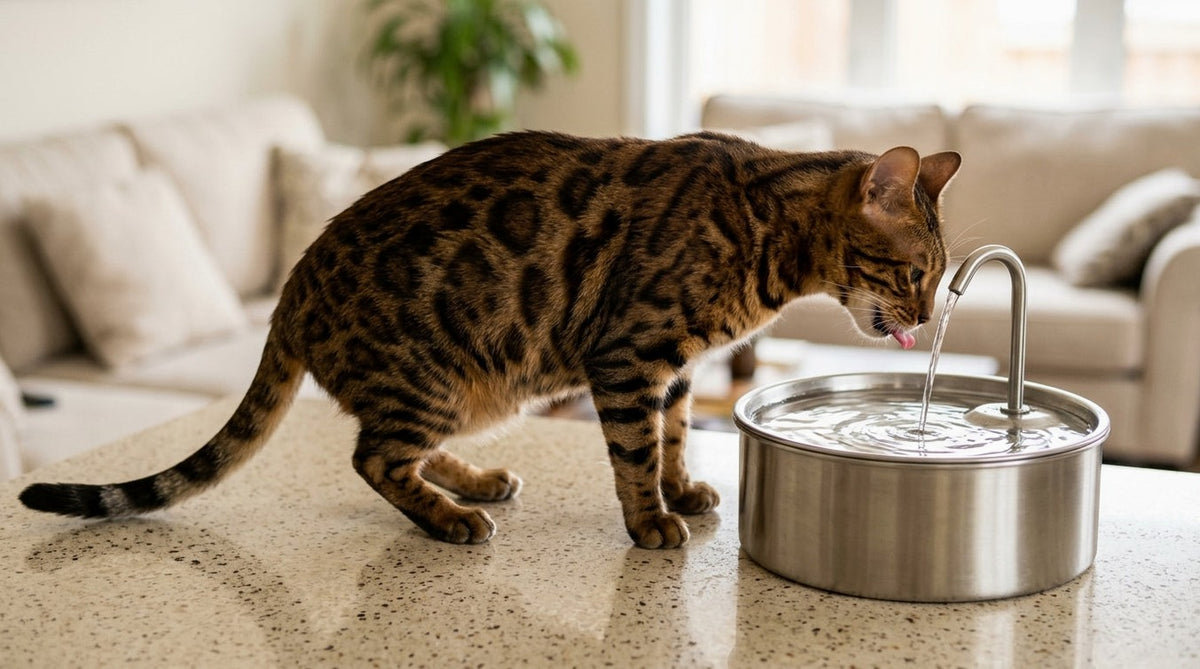
A Bengal that paws at the faucet or plays in the sink isn't misbehaving; it is displaying a breed trait. A fountain channels that energy, offering a faucet-style stream a curious cat can investigate and play with. Place it along your Bengal's usual patrol route and the drinking tends to follow the curiosity.
Since it is made of 304 food-grade stainless steel, there is no plastic for slime to grip, which matters for a cat this hands-on with its water. A wireless design lets you move it to whatever perch your Bengal has claimed this week, with no cord across the floor to chew and one less thing to supervise.
The benefit is simple: a Bengal that drinks more is a better-hydrated, healthier cat, and you no longer have to leave the faucet dripping each morning.
If that faucet obsession sounds familiar, get the Wireless Cat Fountain 2.0 and let your Bengal drink the way nature intended.
Which Homes Suit a Bengal, and Which Don't
So who really does well with a Bengal? Answer honestly, because this matters more than any online quiz, and the breed is not right for every household.
Your Available Time
A Bengal needs genuine interaction daily. If you work long hours and the house sits empty, this energetic cat will have a hard time, and frankly so will you.
Bengals fit people who are home often, want a hands-on pet, and can make time for interactive play every day, not only on weekends.
Room to Climb
Set floor area aside for a moment, because height is what counts. Bengals love to climb and need vertical territory: tall cat trees, wall-mounted shelves, and a window perch for surveying their domain.
For an indoor Bengal, a small apartment with plenty of climbing options beats a large house with nothing to scale.
Homes With Small Children
Bengals can make excellent family pets, particularly with children old enough to play gently and respect a cat's limits.
With toddlers, the breed's high energy and hunting instinct mean constant supervision is essential for everyone's safety, and early socialization helps a great deal.
Other Animals in the House
Many Bengals live happily with other cats and even dogs, especially when they grow up together and are well socialized from the beginning.
However, that strong hunting drive puts small pets such as hamsters, birds and fish at real risk, and a shy resident cat may find a Bengal's energy draining.
Bengals for First-Time Owners
Truthfully, a Bengal is a challenging first cat. It can certainly work if you are new to cats, but go in prepared, with a plan for all that energy and a willingness to learn quickly. A relaxed, easygoing lap cat this is not.
Helping Your Bengal Thrive
Nearly every demanding Bengal trait becomes manageable once you give it an outlet. Here is how to help your Bengal live a happy, settled life.
Daily Exercise Is a Must
Active, interactive play needs to happen daily, not just a toy left lying on the floor. Wand toys, fetch, and laser chases that end with something your cat can actually catch all work well.
Two twenty-minute sessions a day use up the energy that would otherwise become mischief.
Provide Plenty of Height
Give your Bengal places to climb. Cat trees, wall shelves and perches let it climb, observe and feel safe, and that vertical space spares your curtains and countertops.
Feed the Brain With Puzzles
Make that clever mind earn its meals. Puzzle feeders, treat-dispensing toys like the Smart Interactive Cat Ball, and simple hide-and-seek games turn feeding into enrichment and slow down a smart cat that would otherwise be bored before noon.
Stick to a Consistent Schedule
Routine is more important than you might expect. Feeding, playing and settling down at about the same times every day help an intense Bengal feel secure, which usually means fewer early-morning wake-ups and a calmer household.
Avoid Long Stretches Alone
If you are away all day, make a plan. Another pet, a midday visit, food puzzles and a fountain to explore all help a sociable Bengal cope.
Ultimately, though, this loving cat craves company and is happiest when it has plenty.
Final Verdict: Should You Get a Bengal?
In short, Bengals are loving, hilarious and genuinely demanding. Give one enough daily play and companionship and you will share your home with the most engaging animal you have ever known.
Leave that same cat bored and alone, and neither of you will be happy. If that trade-off sounds worth it, you may well be a Bengal person. 😺
Bengal Temperament: Common Questions
Do Bengals make good pets?
Yes, in the right household. Bengals are loving, smart and endlessly amusing, but they are also energetic and demanding, so they suit active people who can offer time, play and company.
If you are looking for a calm, low-effort lap cat, a Bengal probably isn't the one.
How cuddly are Bengals?
Very affectionate, in their own way. Bengals form close bonds and love being part of everything you do. Their affection is active and on their own terms, more following you around and helping with chores than curling up quietly for hours.
Is aggression a problem with Bengals?
Not inherently. Bengals are bold, lively and intense rather than aggressive, though boredom, overstimulation and rough play can lead to nipping or reactive moments.
Lots of exercise, gentle handling and respecting their boundaries keep things friendly. If aggression shows up suddenly, it is worth a visit to your vet.
Do Bengals need a lot of care?
In terms of time and attention, yes. Their short coat is easy to look after, but their need for exercise, mental challenge and company makes them one of the more demanding breeds to keep truly content.
Will a Bengal get along with my other cats?
Frequently, yes, particularly when they grow up together and are well socialized. A confident, playful, energetic companion makes the best match.
A timid or older resident cat may be overwhelmed by a Bengal's energy, so pair similar temperaments and let introductions move at the calmer cat's pace.
What is a Bengal's typical lifespan?
A range of 12 to 16 years is often quoted, and many Bengals do reach it with good care. The full picture is less rosy, however. A large veterinary study in the UK found a median life expectancy of roughly 8.5 years for the breed, shorter than for cats overall.
Part of the reason is that Bengals are susceptible to inherited diseases such as hypertrophic cardiomyopathy (HCM), progressive retinal atrophy, and pyruvate kinase deficiency, a hereditary form of anemia.
Choosing a health-tested breeder, keeping your cat at a healthy weight and scheduling regular vet checkups give your Bengal the best chance of reaching the higher end of that range.